Why Aaron Rai winning the 2026 US PGA Championship was a fitting victory in Rocky Balboa's backyard
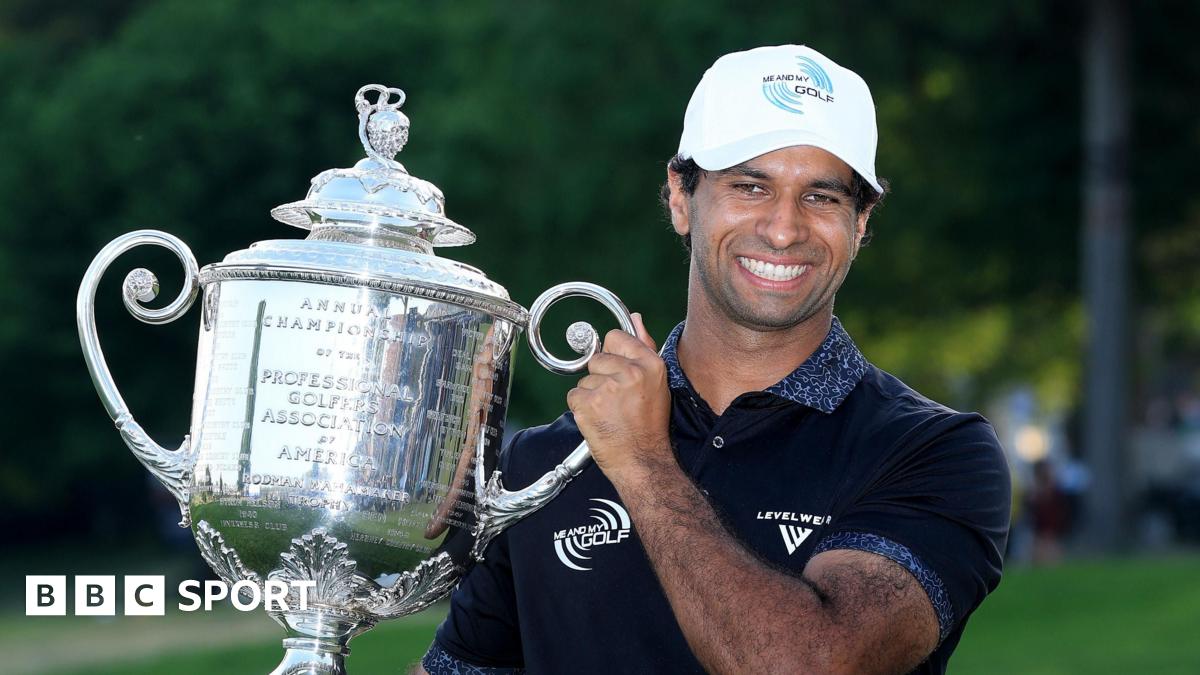
It feels fitting that an underdog who uses what some consider unorthodox methods was last man standing at a slugfest of a US PGA Championship held in Rocky Balboa's backyard.While Aaron Rai waited for his arm to be held aloft in Philadelphia as a first-time major champion, the 31-year-old Englishman could hear Eye of the Tiger - the unmistakable theme tune written for Rocky III - playing in the background as he received congratulations in the Aronimink clubhouse.Rai doesn't punch hanging slabs of meat with his bare knuckles while training like the iconic boxing character.He is rarely bare knuckled on the golf course. Unusually, Rai wears two gloves instead of the one which virtually everyone else across the world - professional and amateurs alike - wears for enhanced grip."I just happened to be given two gloves and I got into the habit of wearing them," Rai said of his early forays into the game."Then, a few weeks down the line my dad forgot to put the two gloves in the bag, so I had to play with one. It was terrible."I couldn't play - I couldn't feel the grip - so I've always stuck with the two gloves ever since."The quirky look is only one part of what makes Rai's fascinating journey from Wolverhampton to the summit of the golfing world different.In fact, it was only by accident - and literally because of one - that Rai took up golf at all.Playing with his older brother's hockey sticks as a toddler ended in Rai copping a nasty bruise on his head, leading to mother Dalvir heading to the shops for plastic versions which she thought would be safer.Instead, she came back with plastic golf clubs - and changed the course of her son's life.Rai harboured hopes of becoming a Formula 1 driver as a youngster, but it was an idea which was quickly overtaken."I used to love watching [seven-time world champion] Michael Schumacher, and it ran so deep that in junior golf competitions I wore Ferrari T-shirts and jumpers," Rai told BBC Sport in 2018."That was my thing even from a young age. But since eight or nine, it became very quickly just about golf."Rai's ability became apparent as soon as he started regularly going to the 3 Hammers Golf Complex in Wolverhampton at the age of four.Footage exists of a five-year-old Rai demonstrating his prodigious talent to local BBC television reporters after winning his first tournament.Rai's father Amrik used to take him to 3 Hammers for lessons with instructor Darren Prosser, with the youngster going out on the par-three course afterwards to put what he had been taught into practice.Rai already possessed a rare tunnel-visioned focus - a trait which enabled him to secure victory at Aronimink - for a player so callow, says Prosser.By the age of 10, Rai was coached by Andrew Proudman - who also worked in the 3 Hammers pro shop - in tandem with another Wolverhampton pro Piers Ward, and the pair still guide Rai to this day.When Prosser's path crossed with Rai again several years later - at an Open Championship regional qualifier in Coventry - he realised the teenager had rapidly developed into a potential tour prospect."I hardly recognised him," Prosser told BBC Radio 5 Live. "In such a short time he'd shot up and he was a really strong guy."He was right on it physically and mentally, and you thought then he was ready to go professional."Rai hailed the impact of his "mentors" Proudman and Ward in his post-victory news conference at Aronimink, but the most gratitude goes eternally to his parents for their sacrifices in helping him reach the pinnacle of his chosen career.An emotional Rai said it was "hard to express everything they mean" to him.Amrik quit his job to devote more time to Rai's development on the course, with Dalvir - who is of Kenyan-Indian descent - working long hours to support things financially."I can't put into words how much they've done in terms of the support, in terms of the care, in terms of love. I wouldn't be here without them at all," said Rai.Very few British Asians have played golf at the highest level and, speaking to BBC Sport in 2018, Rai said pursuing the game professionally might not always have been met with encouragement from some parents of Indian descent.But he said his folks always encouraged him to pursue his dream - especially his father, who turned down a tennis scholarship in the US at the age of 20."Being from an Indian family was different back in those days," said Rai, who turned professional in 2012."It was more about getting an education and a proper job, and sport or tennis at that time was never really seen as a proper job."That pressure to have certain kinds of career was probably there from the previous generation, and certain career paths in our culture are still more walked upon."Since that interview, Rai has developed into a strong role model - not just for British Asians but aspiring golfers from all backgrounds.Rai had to recover from setbacks on the developmental circuits before earning his European Tour and PGA Tour cards, but the success eventually arrived with tournament wins on both sides of the Atlantic.Missing the cuts in his first two majors were experiences from which he learned and, after never finishing in the top 10 at one of the sport's four biggest tournaments, Rai's hard graft has paid off spectacularly."You won't find one person on the property who's not happy for him," said six-time major champion Rory McIlroy.Two-time major champion Xander Schaffeule said: "Rarely do you feel like people work way harder than you."I've played a pretty good amount of time and Aaron is always there. He's always in the gym. He's always on the range."That's what it's about to be a major champion. You put the work in when nobody's looking."Rai has finally been rewarded after a patient and precise performance at an attritional Aronimink.Like the rest of the field, he had to take some punches from a course set-up which wanted to inflict pain with its devilish pins, severely sloping greens and thick rough.But Rai proved, as Rocky famously said, it ain't about how hard you hit - it's about how hard you get hit and can keep moving forward.


Most Popular
Afghanistan mourns passing of Shapoor Zadran
4 hours ago