Is Neymar the first to bookend his international career with goals at the same venue?
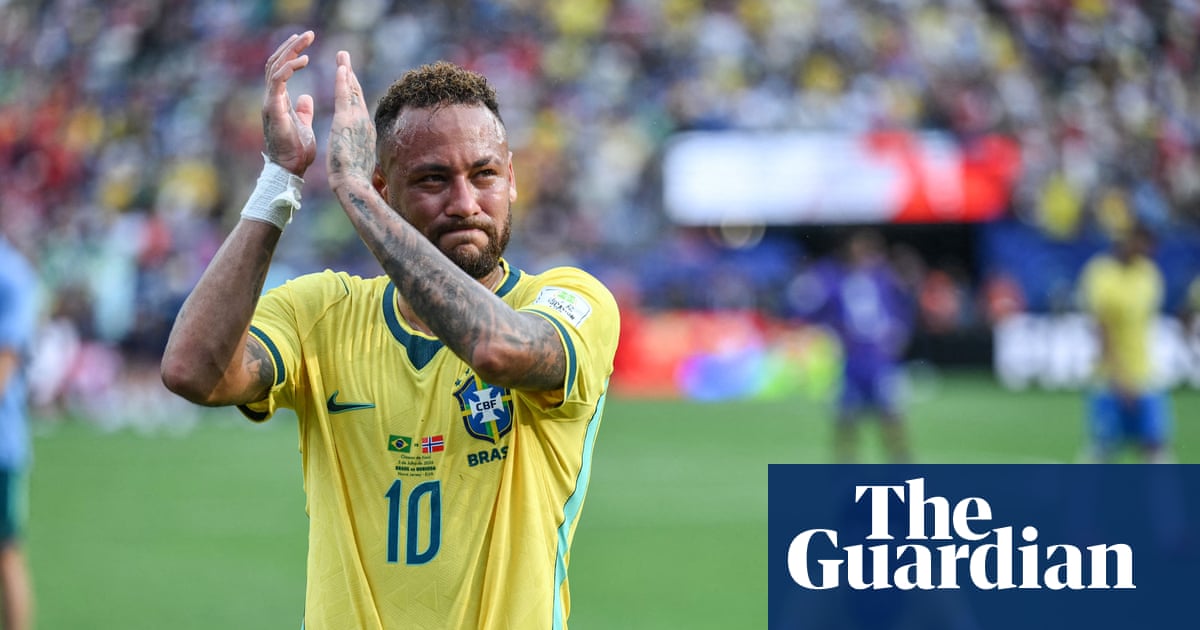
“Neymar’s consolation penalty against Norway at the World Cup means his first international goal, scored on his first cap, was in the same stadium (MetLife) as his last international goal on his final cap,” writes Griffin Cant. “Are there any other players who have bookended their international career in a similar way?”Over 77,000 people were at the MetLife Stadium on 10 August 2010 as Neymar made his Brazil bow in a friendly against the USA. The fresh-faced, dodgy-haircutted 18-year-old scored after just 28 minutes, a thumping header past Tim Howard in the USA goal. Nearly 16 years later, he rolled his penalty – his 80th goal for his country on his 130th appearance – past Norway’s Ørjan Nyland at the same end of the stadium as Brazil exited the World Cup in the last 16 and followed it by announcing his retirement from international duty.Even taking out the one-cap one-goal wonders (hello Francis Jeffers and David Nugent), it feels like it should be a fairly common occurrence but a trawl through the RSSSF archives of the game’s most prolific international scorers reveals it’s not as common as you might think.Mexico’s Jared Borghetti scored his first goal on debut and his 46th and final goal on his farewell appearance but those were separated by around 900km in Mexico City and Monterrey. Similarly, Denmark legend of the 1920s and 30s Pauli Jørgensen managed the impressive feat of scoring twice on his debut and twice in his final game but his first came in Aarhus, his last 14 years later in Copenhagen.Poland’s Wlodzimierz Lubanski bookended his international career with goals on home turf but in Chorzów and Szczecin, around 550km apart. Abe Lenstra, a free-scoring forward for Heerenveen and the Netherlands through the 1940s and 50s, began his international career with a goal in a 5-4 defeat against Luxembourg in 1940 and he scored on his 47th and final appearance for the country against Belgium in 1959. The first game was in Rotterdam, the second 80km away in Amsterdam. Zinedine Zidane scored twice on his France debut – against the Czech Republic in 1994 – and again on his final appearance, in the 2006 World Cup final. But the first was in Bordeaux, the latter in Berlin.England’s Tom Finney scored his first and last international goals in Belfast – but the latter came in his penultimate game for the country, less than three weeks before his final appearance. France’s Just Fontaine had a similar record, with a hat-trick on debut and his final goals coming in his penultimate game (both in Paris), and the same is true for England’s Nat Lofthouse (at Wembley).So the closest we can get to Neymar is Mexico’s Enrique Borja. The striker scored on his international debut against Chile just before the 1966 World Cup and again on his final appearance against the USA in the summer of 1975. Both games were played in Mexico City. The snag? The first game was played at the Estadio Olímpico Universitario and the second at the Azteca, about 7km away across the city.But presumably there must be others who can match Neymar’s achievement, even if they can’t match his goal or cap tally. Send your suggestions to knowledge@theguardian.com.Getting shirty“The heroics of Cape Verde have relit a fundamental question about national team colours,” emails Lars Bøgegaard. “It is baffling that a country with ‘green’ in its name has a predominantly blue flag, but it explains the team’s kit. Why do some countries – Australia, Japan, Germany – play in colours that don’t match their flag?”“Japan play in blue and white partly because of superstition,” writes Ben Chia (and others). “They first used blue shirts in the 1930 Far Eastern Games, where a team from Tokyo Imperial University (whose usual colour is light blue) represented Japan wearing light blue shirts.”As Ben explains, Japan stuck with blue shirts at the 1936 Olympics in Berlin, where they fought back to beat Sweden 3-2 in a landmark win. “They briefly changed to red and white to match their flag between 1988 and 1992, but after failing to qualify for the 1990 World Cup and 1992 Olympics, they reverted back,” Ben adds. The colour change was locked in before the 2006 World Cup, when the Japanese FA created the team’s new nickname – Samurai Blue.As for Australia, virtually all of their national sports teams play in gold and green, and Michael Haughey can explain why. “These colours represent the golden wattle – Australia’s national flower – and the country’s unique flora more generally. ‘Wattle gold’ and ‘gum-tree green’ were adopted by the national cricket team in 1908, and they were proclaimed Australia’s official colours for sport and beyond in 1984.According to their government’s Australia Symbols handbook, green represents forests, gum trees, pastures and “endless horizons of growing crops”, while gold is a symbol of their sporting success, mineral wealth, sandy beaches and harvests of golden grains. OK guys, no need to rub it in.Michael can also explain why Germany play in a predominantly black and white kit (with fashionable red and gold flashes from their national flag). “The German team play in the colours of the flag of Prussia, which became the largest part of the German state at unification in 1871.”Alasdair Brooks, meanwhile, has details of a few other national teams whose colours don’t match their flags:Italy: Play in blue because these were the colours of the former royal family, the House of Savoy, and were kept when Italy became a republic in the 1940s.Venezuela: That fetching maroon originates with the traditional colours of the Venezuelan army. In the late 1930s, the team arrived to play a match in Colombia without uniforms, so the national military let them borrow some of their burgundy kits instead, and the colour stuck.Malaysia: Play in yellow and black, supposedly inspired by the stripes of the Malayan tiger, which also serves as the team’s nickname.India: As with other Indian national sports teams, the football side do use a colour from their flag – the Ashoka Chakra (blue wheel) in its centre. The authorities were apparently concerned that saffron was too closely associated with Hindu nationalism and might alienate players from other faith traditions, while green was too closely associated with Pakistan – so they alighted on blue.Goal difference kings“Senegal ended the group stage with a record of won one, lost two but a goal difference of +2. What’s the highest goal difference a team has achieved while losing more games than winning in a group – and has this scenario ever happened in a domestic league?” asks Mark Payne.Senegal have matched a record set in 2002, write Haydon Bambury and Dirk Maas. “Senegal’s record equals the one set by Portugal in 2002,” writes Haydon. “They lost 3-2 to USA, beat Poland 4-0, then lost 1-0 to South Korea in their final game, finishing P3 W1 D0 L2 F4 A6 GD+2. Sadly for them, 2002 was a 32-team World Cup, so there were no best-placed third place teams going through and they had to pack their bags.”Domestically, we’ve looked at teams being relegated with a positive goal difference a couple of times before and the scope for a losing record coupled with a positive goal difference is obviously much higher over a lengthy season.Knowledge archive“Scotland were the only unbeaten side at the 1974 World Cup, yet were knocked out at the group stage. Has this happened before or since?” asked Peter Sagar in 2018.Scotland’s 1974 side drew with Brazil and Yugoslavia, but went out on goal difference after beating Zaire 2-0 in their opening game. Brazil (3-0) and Yugoslavia (9-0) bettered that – and a number of other teams have gone out in similar circumstances.New Zealand were the only unbeaten team at the 2010 World Cup, after drawing all three group games. The same happened to Cameroon in 1982 and Belgium in 1998 – and we can also add Iran in 2026. A couple of teams had even longer unbeaten runs without winning the tournament, though.England played five matches in 1982, going out in the second group stage, while Brazil played seven in 1978. Three in the first group stage, three in the second – when they were eliminated on goal difference after Argentina’s controversial 6-0 win over Peru – and one in the third-place playoff, when they beat Italy 2-1.A number of teams have remained unbeaten in normal and extra-time but went out on penalties. The list includes: Brazil and Mexico in 1986; Italy in 1990; Italy and the Netherlands in 1998; Ireland and Spain in 2002; Switzerland, Argentina, England and France in 2006; Costa Rica and the Netherlands in 2014; plus Spain and Denmark in 2018.The Netherlands did it again in 2022, losing on penalties to Argentina – and again at this tournament, going out to Morocco on spot-kicks after an unbeaten group campaign. Finally, a word for Cape Verde, who drew their three group games and lost to Argentina in extra time – going home without being beaten inside 90 minutes.Can you help?“Jordan Henderson broke his wrist celebrating England’s win over Mexico, thus managing to get booked and injured in a game that he didn’t actually play in. Has any other unused substitute done this?” asks Tom Francis (and others).“Sweden’s 5-1 victory against Tunisia was followed by a 5-1 defeat against Netherlands,” writes Dirk Maas. “Are there more examples of stunning World Cup wins followed by heavy defeats with the similar scoreline (or vice versa: heavy defeats followed by stunning wins with the same scoreline)?”“After Paraguay somehow managed to get zero yellow cards against France despite committing 13 fouls, what’s the highest number of infringements a team has totted up in a game without collecting a caution?” wonders Jim Hearson.“Lionel Messi is Argentina’s youngest and oldest goal scorer – has any other footballer achieved this accolade or is likely to in the future?” asks Paul Gage.

Most Popular



2026 World Cup Round Of 16 Power Rankings
7 hours ago