Singapore football fraternity divided over controversial World Cup hydration breaks
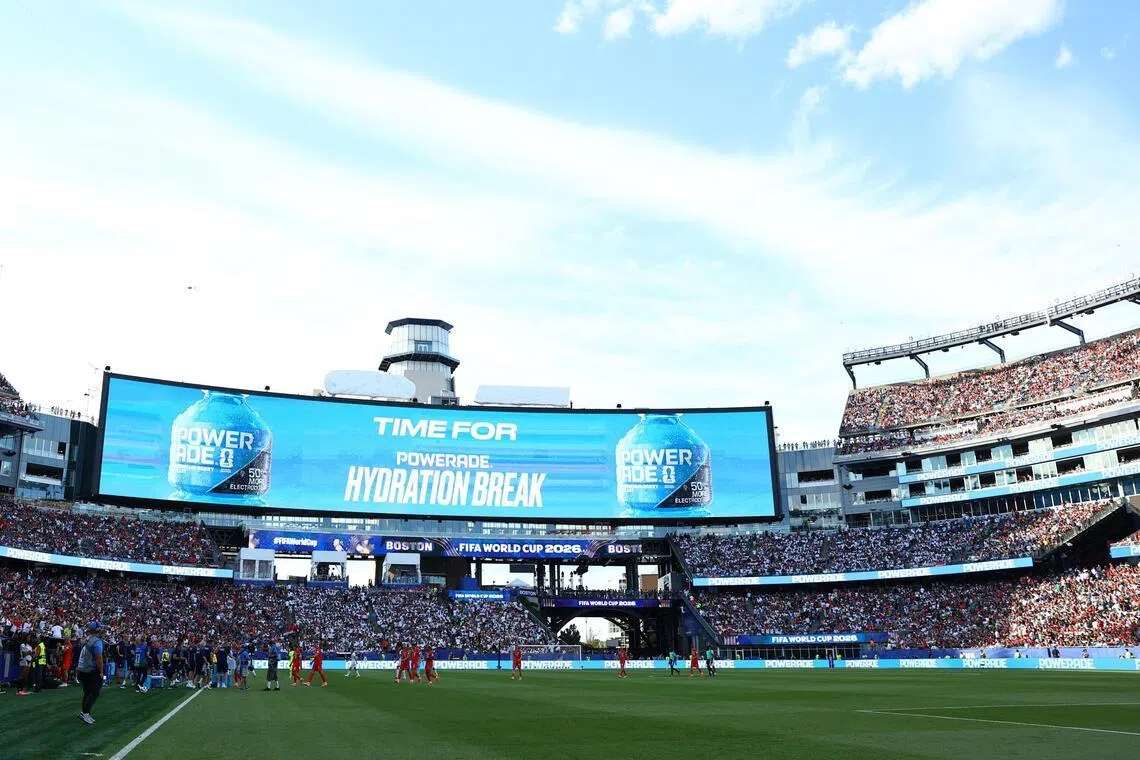
SINGAPORE – Loud boos echoed around stadiums in North America this week, with fans showing hydration breaks the red card at the FIFA World Cup, particularly on June 17 during the England-Croatia and Ghana-Panama games.World governing body FIFA’s mandatory three-minute breaks to help players cope with the summer heat and humidity during the tournament have been controversial.Some critics say they affect the flow of the game, while others noted that it has turned a game of two halves into an American-style sport of four quarters – like the National Football League – to allow for advertisements.Many are claiming that FIFA has gone offside with the decision.For the record, the concept of water breaks is not new. They were first introduced at the World Cup in 2014 on a case-by-case basis in Brazil and activated at the referee’s discretion when Wet-Bulb Globe Temperature – which factors in heat, humidity, wind and cloud cover – exceeded 32 deg C.Locally, one-minute water breaks were also introduced in the Singapore Premier League in 2020 and 2021 as action returned following a Covid-19 enforced suspension of the professional football league. These were discontinued from the 2022 season.Singapore’s football fraternity and local experts whom The Straits Times spoke to were divided on the mandatory hydration breaks, with some calling it a positive move for players and match officials when conditions are unbearable, while others noted that they can be disruptive to the game.“The mandatory three-minute breaks in the middle of each half could help players and referees manage the physical demands of playing in hot and humid conditions, giving them time to hydrate and cool down, said scientists from Sport Singapore’s High Performance Sport Institute and National University of Singapore’s Heat Resilience and Performance Centre.“This can help them maintain a higher level of performance by delaying fatigue.”National football captain Hariss Harun noted that “players don’t complain” about having the breaks.The Lion City Sailors skipper and Football Association of Singapore vice-president, who attended the 2025 World Club Cup semi-finals and final at the MetLife Stadium in the United States, said: “The summer afternoon kick-offs can be really hot and humid. If it felt uncomfortable in the stands, what more the players who have to compete on the pitch.“So, from a player point of view, such breaks can help us hydrate and perform better.“But as a viewer, it can be disruptive, and also for teams, if the game is free-flowing and one team are on top.”Football fan Ryan Tan was on the fence about the hydration breaks.The 42-year-old software engineer said: “If it is an exciting game with one team clearly having the upper hand, the extra breaks can kill that momentum and spoil the match as a spectacle.“But on the other hand, if it is a boring game, it can be a nice respite for viewers to take a break, and hopefully the teams can regroup and produce better play afterwards.“I’m just not sure to what extent the organisers want to keep changing the game. Will there be ‘heating breaks’ in winter conditions too?”At the ongoing tournament, Dutch defender Virgil van Dijk and United States coach Mauricio Pochettino questioned if they are necessary when matches are played in kind and conducive conditions.Similarly, James Walton, sports business group leader at Deloitte Asia-Pacific, added: “There have been games at this World Cup where the temperature has been 15-17 degrees, and we still saw hydration breaks because they are pre-programmed and scheduled in, no matter what the weather, in order to allow for ad breaks.”While he felt that the breaks are useful when it gets hot and humid in Mexico, and in the south of the United States, he also pointed out that there are already natural breaks, for example during injuries or video assistant referee (VAR) checks during matches when players get the opportunity to hydrate.He added: “If it is presented as a necessary thing for the health and well-being of the players, FIFA would implement it based on a certain level of temperature, and wouldn’t be in a position to pre-determine and sell ad breaks and make any revenue.“So, you can make your own mind up about what was really driving the decision-making factor here.”Hougang United coach Akbar Nawas agreed that the water breaks should occur only on an as-needed basis, with the best interests of the players and the game at heart. And teams have to manage any disruption to the game, as they have done for the introduction of VAR.He said: “Any stoppage can affect the flow of the game, and we always want the rhythm to continue, but the reality is football today is much more physically demanding. With things like VAR also adding interruptions, managing the flow of the game has become part of modern football.“For coaches, we can also use these moments to give some quick pointers about pressing, positioning, or where we can hurt the opponent.”Stressing that hydration breaks should be dependent on temperature and humidity, he added: “At tournament level, they can be important because players need to maintain their intensity, concentration and decision-making throughout the match.“For me, the main thing should be about the conditions and the welfare of the players – only if the weather requires it, then it should be part of the game.”



Most Popular