Can S'pore football replicate Cape Verde’s World Cup success?
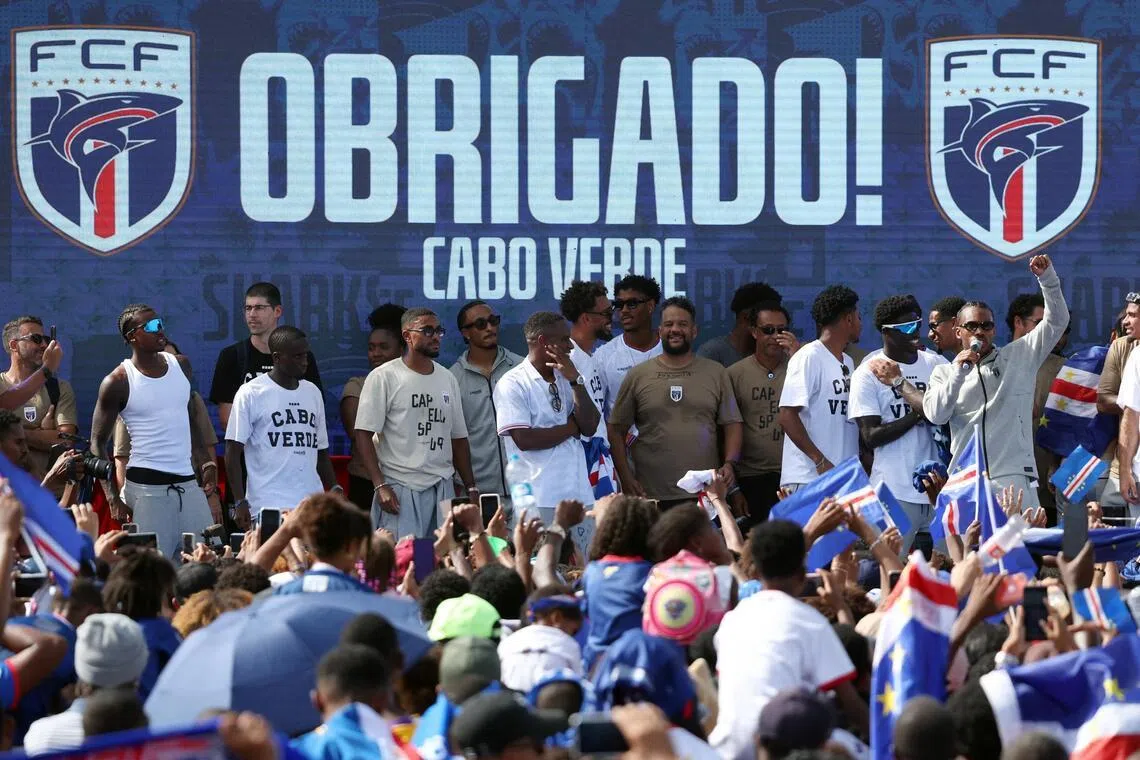
SINGAPORE – Cape Verde’s fairy-tale journey to the 2026 World Cup includes a hunt in the most unlikely of places – networking platform Linkedin.This was how the West African island of over 500,000 people managed to recruit a player, with their assembled team eventually going on to frustrate two former world champions, become the smallest nation ever to reach the knockout stages and give holders Argentina a mighty scare.The Blue Sharks’ remarkable run has sparked comparisons with Singapore, with netizens taking to social media to ask why a country of just over 500,000 people can qualify for the tournament and make a deep run, but not Singapore, which has 3.7 million citizens.Despite being crowned Asean champions four times, Singapore have never qualified for the World Cup. The Asian Cup in 2027 will be the farthest that the Lions have gone, after earning a spot in November 2025.Comparisons between Singapore and Cape Verde, or even Curacao – a Caribbean island nation of about 160,000 people – are inevitable, given all three have a limited talent pool and small land size.Before these nations, there was Iceland, who also triggered soul-searching here after it qualified for the 2018 edition in Russia.Experts whom The Straits Times spoke to stressed that comparing Singapore with the two nations is not the fairest, but noted that the Republic can reap lessons from Cape Verde’s journey.Reliance on diasporaWhile the resident population of Cape Verde is over 500,000, the diaspora is estimated to be well over one million people.The nation has a history of mass emigration, with at least 700,000 Cape Verdeans living abroad today – many are based in the United States and Europe (including over 100,000 people in Portugal).The Cape Verdean Football Federation has tapped into this diaspora for the national team.Defender Roberto Lopes, who was born in Ireland, was recruited via LinkedIn. Fourteen members of their 26-man World Cup squad were born abroad while several players born in the archipelago were developed in Portugal.Cape Verde remained a Portuguese colony until 1975, and Portuguese continues to be the country’s official language, contributing to enduring cultural and sporting links.Migration has been part of the World Cup story since its inception, allowing for teams to dip into a larger pool of footballers, and increase the diversity of skills available within a squad.Curacao are another who rely heavily on their diaspora in the Netherlands.Former Football Association of Singapore (FAS) general secretary Yazeen Buhari said that while the comparison with Cape Verde and Curacao is understandable, he noted that “it is important to appreciate that every football nation operates within a different context”.The consultant with FIFA and the Asian Football Confederation (AFC) added: “ Both Curacao and Cape Verde have been able to draw significantly from their diaspora, giving them access to players who have developed in much mature football ecosystems outside their countries. Singapore’s circumstances are different. Our overseas player pool is considerably smaller, and our social policies have understandably been designed around maintaining national cohesion and our unique social fabric.“So that’s a key distinction we need to acknowledge.”Ganesh Rajaram, a former sports journalist and a former Nominated Member of Parliament (NMP) said that “comparisons need to be made carefully”.He added: “Cape Verde and Curacao benefit from large football diasporas, with many eligible players developed in some of the world’s strongest football ecosystems. Singapore simply does not have that same structural advantage.“While we should certainly continue to identify and engage eligible overseas-based Singaporeans wherever possible, I don’t believe our long-term success can or should depend on a diaspora strategy.”There has been a concerted effort from the FAS in recent years to seek overseas-based players eligible to represent the Lions. Cardiff City’s Liverpool-born footballer Perry Ng, 30, is in line to become the first to don national colours via the heritage route if he gets his Singapore passport. Ng is in the midst of his citizenship application after attaining permanent residency in March 2025.Welsh central midfielder Kai Whitmore, whose maternal grandfather was born here, has expressed interest in playing for the Lions and in April joined Singapore Premier League side Young Lions.World football governing body FIFA’s rules stipulate that individuals must have “a genuine link” with national teams they intend to play for. The basic criteria are: place of birth, naturalisation by residence or place of one grandparent’s birth.However, Singapore’s citizenship rules state that qualifying for a passport by descent is applicable only to individuals with at least one parent who is born in Singapore or is a citizen by registration.Special dispensation could be made for Ng to represent the Lions through the Foreign Sports Talent scheme. Japan-born midfielder Kyoga Nakamura and South Korea-born midfielder Song Ui-young attained Singapore citizenship after being based here for at least five years. They are now key players for the Lions, who are preparing for the 2027 Asian Cup.James Walton, sports business group leader of Deloitte Asia Pacific and South-east Asia, said that while Singapore is following a global trend in recruitment of overseas-heritage players, there was a key distinction.He argued that Singapore’s diaspora was primarily formed through educational and professional migration rather than economic necessity, unlike those from countries such as Curacao and Cape Verde. He noted that “the diasporas that tend to produce athletes are generally those shaped by economic migration”.He also pointed out that although Singapore is seeing more children with “mixed nationality parents” – such as those with a European and Singaporean parent, or children born here to long-term resident foreign parents, there are “structural obstacles unique to Singapore”.“This goes beyond football,” said Walton. “Firstly, the rule that says that you have to pick your nationality, and you can’t have dual passport because a lot of people in this situation in other parts of the world can be carrying two passports. The second thing is national service.”Where’s the Singapore dream?The Lions are ranked 148th in the world, which is the sixth highest in South-east Asia behind Thailand, Indonesia, Vietnam, the Philippines and Malaysia.Following the expansion of the World Cup to 48 teams, there are eight direct spots and one intercontinental play-off slot allocated to the continent by FIFA. Driven by their diaspora of Dutch-born talent, Indonesia came the closest to making it to the fourth round of the 2026 World Cup qualifiers.In 2021, the Singapore Government launched Unleash the Roar! (UTR), a project aimed at improving and transforming Singapore football. Through UTR, aspiring young players have received better support and development opportunities through overseas scholarships and the Singapore Youth League (SYL).The aspirational target then was qualification for the 2034 World Cup.With just eight years to go, results across youth competitions – such as continued failure at the SEA Games – do not inspire confidence.But the maiden qualification for the 2027 Asian Cup has brought a feel-good factor to Singapore football, and FAS president Forrest Li’s announcement in March that tech company Sea Limited will donate $50 million to support the long-term development of football here has given the sport a boost.Yazeen said: “There is a genuine bounce in our steps today with the optimism surrounding our national team, and I hope that marks the beginning of a journey that inspires the next generation to believe that football is a viable career, and representing Singapore at the highest level are valued possibilities.”Walton said that a key reason for Curacao and Cape Verde’s success is the players’ professional environment, as the majority of their players came through the European development system. Stating that there is still a “development gap” here, he added that competition and coaching quality between ages 15 and 19 are not up to par to produce elite players.Walton said: “How do you get better? You need a certain level of competition, and the level of competition is not here. That is why UTR is sending people on scholarships because they know it too. They recognise that the development will be better overseas and as long as that is our situation, as long as that is our constraint, that’s a problem.”‘There is no magic formula’Ganesh felt that Singapore’s real advantage lies in how it has “consistently shown that when we decide something is strategically important, we are capable of building world-class systems”. He also noted the Government’s significant investments in sporting infrastructure, facilities and athlete support.“Today, Singapore has facilities that many countries would envy, and those investments deserve recognition,” said Ganesh.“The next phase of our sporting journey is less about hardware and increasingly about software. By software, I mean investing in human capital: exceptional coaches, technical directors, high-performance specialists, sports scientists, performance analysts, talent identification experts, sports psychologists and sporting administrators. These are the people who create winning cultures, build sustainable high-performance programmes and ultimately develop elite athletes. ”Population size alone is neither an advantage nor disadvantage, said Walton, pointing to the repeated failures of the world’s two most populous countries, China and India, to qualify for the tournament.Stressing that Singapore will need four to five “generational talents” to make the World Cup, Walton also argued that “small-nation football success requires several things to align at once”, noting that the likes of Iceland and Cape Verde have benefitted from a golden generation.Three issues that will hold Singapore back, he added, are physiology, level of focus on a specific sport, and circumstance.The first is “a bit of a question mark” for this region, which he felt explained why Asean nations have struggled to make a mark.On the level of focus, he added: “I think one of the things that we suffer with vis-a-vis places like Norway, Croatia, Cape Verde, name me a sport where they are as passionate about as football.“We seem to be a little bit split in that regard, in terms of multiple sports. If you’re a large nation, like England, with cricket, rugby... you can maybe get away with, but what served Iceland and Cape Verde so well is that football is their main sport.”On circumstance, he noted that in countries like Cape Verde, football often represents the clearest path to a better life.But in Singapore, the sport has to compete with opportunity costs and more financially sound alternatives. That gap, Walton argued, shapes societal attitudes and how much parents will push their kids into sport.Only once the three factors align, he said, does infrastructure become the deciding factor.“There is no magic bullet. There is no magic formula,” he said.Belief goes a long wayCape Verde’s journey at the World Cup was inspiring for many owing to the grit and determination they showed against giants such as Spain, Uruguay and Argentina.Yazeen said that this is a quality that can be replicated, adding: “We regularly witness nations even within our region producing upsets, not necessarily because they possess greater technical quality, but because they play with absolute conviction, resilience and collective purpose.“That mentality is something every football nation, regardless of size, should aspire to cultivate in players, especially from their formative years.“Can Singapore qualify for a World Cup one day? I believe it is possible, particularly with the expanded tournament. Selective naturalised players who genuinely buy into representing Singapore can certainly help strengthen the national team, but they should complement, not replace, the long-term development of our own football ecosystem.“Ultimately, we will not get there by simply copying another country’s model.”Sport psychologist Lim Han Ee noted that the question should not be whether Singapore can simply imitate Cape Verde or Curacao, but whether it can find its own pathway as a nation.“For me, that pathway has to be built around a stronger culture of mastery,” said Lim.“Many years ago, I asked a group of grassroots rugby coaches in New Zealand why the All Blacks were so consistently successful. Almost every one of them gave the same answer: ‘It’s because our job is to raise an All Black’.“ Great football nations are rarely built by one federation or one generation of talented players. They are built over decades by coaches, schools, clubs, parents, communities and players all pulling in the same direction. If Singapore is serious about one day qualifying for the World Cup, our biggest challenge is not just producing better players, but building an environment where excellence can be nurtured, sustained and passed from one generation to the next.”


Most Popular

ups, kickoff times, how to watch – all you need to know
34 minutes ago