
Sony's autonomous robot becomes first to beat pro table tennis players
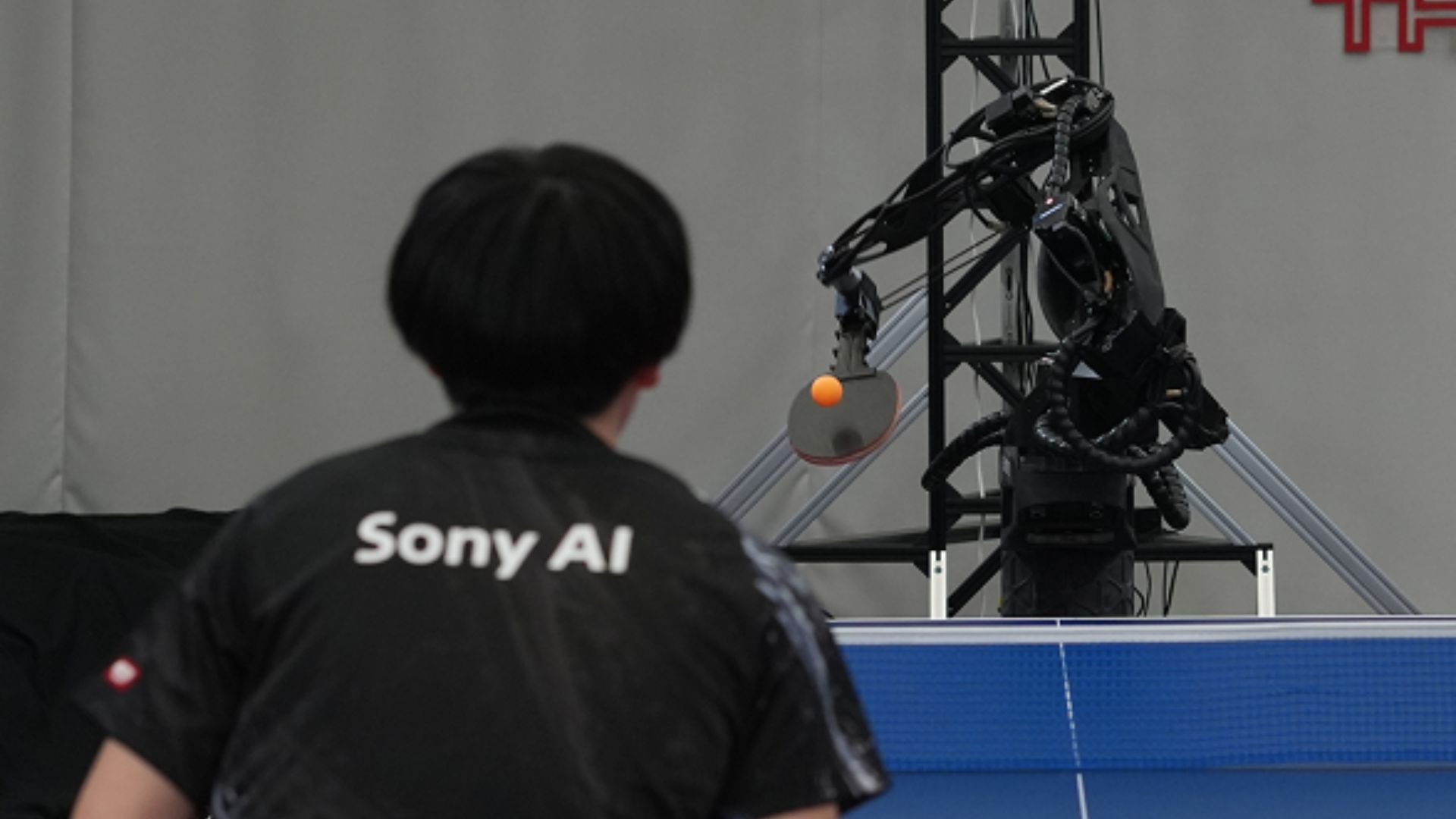
Sony AI has unveiled a major robotics milestone with Project Ace, an autonomous system that competes with elite human table tennis players.The announcement marks a rare breakthrough in physical AI. Robots have long dominated digital games.Real-world sports, however, remained out of reach due to speed and unpredictability. Ace changes that.For years, AI excelled in virtual environments like chess and racing simulations.Physical interaction posed a harder problem. It requires split-second sensing, planning, and movement.Ace builds on earlier work like Gran Turismo Sophy.That system mastered high-speed racing in simulation. Ace brings similar intelligence into the physical world.Sony AI combined advanced sensors, reinforcement learning, and precision robotics.The system tracks fast-moving objects and reacts in milliseconds.Table tennis pushes these limits.The sport demands speed, spin control, and rapid adaptation.“This research has shown that an autonomous robot can, in fact, win at a competitive sport, matching or exceeding the reaction time and decision making of humans in a physical space,” said Peter Dürr, Director of Sony AI in Zürich, and project lead for Ace.“Table tennis is a game of enormous complexity that requires split-second decisions as well as speed and power. This research breakthrough highlights the potential of physical AI agents to perform real-time interactive tasks, and represents a significant step toward creating robots with broader applications in fast, precise, and real-time human interactions.”Engineering for extreme speedAce relies on a dense sensing system. It uses nine high-speed cameras to track the ball’s 3D position.Additional event-based sensors capture spin and angular velocity in real time.The system pairs this with reinforcement learning. It does not rely on fixed rules. Instead, it adapts during play.This allows flexible responses to unpredictable shots.The robot also uses high-speed actuators for precise movement.These enable quick returns even under extreme spin conditions. Engineers designed the system to handle edge cases.These include net deflections and unusual ball trajectories.Tested against professionalsSony AI evaluated Ace under International Table Tennis Federation rules. The robot faced five elite and two professional players.Ace won three out of five matches against elite players. It also delivered competitive performances against professionals.The robot handled spins up to 450 rad/s with over 75% return rates. It scored 16 direct points on serves. Human opponents scored eight.Follow-up matches in late 2025 and early 2026 showed further gains.Ace defeated multiple professional players and improved rally speed and shot placement.“These results demonstrate, for the first time, the potential of physical AI agents to outperform human experts in interactive, real-time tasks,” Sony AI noted in its findings.Peter Stone, Chief Scientist at Sony AI, emphasized broader implications.“This breakthrough is much bigger than table tennis,” he said.“It represents a landmark moment in AI research, showing, for the first time, that an AI system can perceive, reason, and act effectively in complex, rapidly changing real-world environments that demand precision and speed. Once AI can operate at an expert human level under these conditions, it opens the door to an entirely new class of real-world applications that were previously out of reach.”


Most Popular






What Patriots hoped to accomplish on Day 3 of the NFL Draft
26 minutes ago
