Let’s talk about Mikel Oyarzabal: Spain’s quiet man forced into the limelight
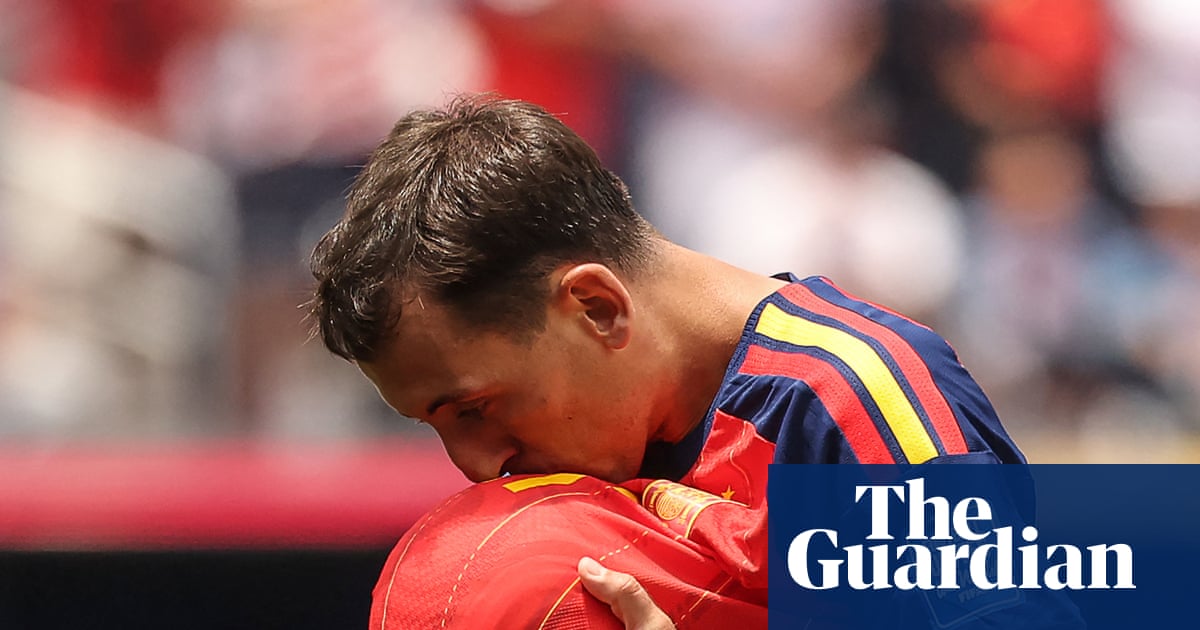
We have to talk about Mikel Oyarzabal. When Spain scored their third goal against Austria in Los Angeles, cameras caught Lamine Yamal’s little brother celebrating, fists clenched and shouting “come on!”. The picture couldn’t have been more perfect, and not just because Keyne is impossibly cute. Even the apparent imperfection was just right. On the row below, clapping and half-hiding the three-year-old, was a woman in sunglasses, prompting a Spanish TV commentator to post: “The blonde in front has denied us the best sticker of all time.” To which the striker Borja Iglesias replied: “The blonde in front has given you two goals today, my friend.”Turns out the blonde woman is Oyarzabal’s mum: her name is Dorleta and it was her son who had just scored his second goal of the game and his fourth of the tournament. Two days later, after the Selección had finished their first training session in Dallas, Marca asked Oyarzabal if he had seen the footage.“Yes,” he said, “[Keyne] is almost like an icon himself given everything that’s happened these last few years and with the transcendence Lamine has.” The unlike me went without saying; with Oyarzabal, most things do. He’s not an icon and doesn’t really want to be. People tend not to talk about him, which is the way he likes it.However, things are changing. Goals change the conversation; and there have been a lot of those from Oyarzabal lately. A coach’s campaign can’t hurt either, with Luis de la Fuente attempting to right a wrong. At the press conference before facing Uruguay, when one question included Oyarzabal’s name, the Spain head coach seized on the opportunity, started his answer by saying “thank you” and turned attention to his No 21. A few minutes later there was another, this time directly about the Real Sociedad striker, and De la Fuente ended his answer by again saying “thank you”, grateful that some small justice was being done.“You mentioned Mikel Oyarzabal: at last, at last, we’re starting to recognise him in Spain. Madre mia! At last,” Spain’s coach had begun. Oyarzabal, he said, was “a great among greats”, which is true: the first six names on the World Cup top scorers table are Kylian Mbappé, Lionel Messi, Erling Haaland, Harry Kane, the Ballon d’Or winner Ousmane Dembélé and Oyarzabal. Five superstars and … well, him.This whole “player is underrated” thing can be overplayed, a tired trope. Recognition comes for a reason, sometimes even the right one, and the lack of celebration isn’t always a crime. There are moments when being underrated even ends up becoming almost a means of overrating a player, another quality to add to the equation. Yet with Oyarzabal there is something in that. He is 29 and until recently he has rarely been talked about, certainly outside San Sebastián, where he is captain of Real Sociedad.That is part of the reason. Oyarzabal has lifted two Copa del Rey titles with la Real – 50% of all the cups they have won – and he scored in both finals. But it is la Real, so there is no lobby and limited opportunities to win. There has been no transfer talk to generate interest, which is in itself interesting: Oyarzabal came through the Real Sociedad academy, his buyout clause is only €75m – inferior players have gone for far more – but there have barely even been rumours. In part because Oyarzabal, who has no agent and is happy at home, has never fed them.That is his way; if he hasn’t been sold, he has never sold himself. After the Austria game he was asked how he felt about being alongside Mbappé and Messi. “I don’t care,” he said, and he meant it. He has a nice line in deadpan, not bothered by the noise. There isn’t the slightest hint of arrogance. Asked how it felt that an AI query about the best strikers returned Mbappé, Kane and Haaland but not him, he replied: “Well, they are the best.”Oyarzabal says that one of the things he has to do as a striker is not get in the way. It is not false modesty, it is actual analysis. It may also be among the reasons he hasn’t always been seen: he doesn’t want to be, off the pitch or on it. Quiet and ordinary looking, everything done without fuss, he is not big and not fast, he doesn’t dribble past anyone, smack them in from 40 yards or feel the urge to be involved for involvement’s sake, to demand the ball; he doesn’t have a clear checklist of immediately apparent qualities. There’s something less tangible about his game, more about timing and interpretation, playing for others.“Since I was little I’ve tried to understand play and why things happen,” he says. “I’ve learned that by not getting in the way you can help. There are moments in which, just by positioning, you can help the team without even touching the ball. It’s then about making the most of the few you have. As a striker you can’t expect to touch the ball every minute.”De la Fuente says: “Mikel is a very intelligent person and you see that on the pitch. He’s one of the best strikers going into space, between lines, dropping to the wing. He’s played right wing, left wing, second striker and centre‑forward and always played well. Very few footballers have his ability to interpret the game. He has the humility and understanding to keep his feet on the ground, because this is a merry-go-round. He is an example to everyone and I’m more delighted with him by the day. People who understand football value him extremely highly. Unfortunately, there are others who don’t see it but the weight he has in the Selección is brutal.”They do now, the numbers ensure as much. De la Fuente had always believed in him. When he took over as coach, he made Oyarzabal one of the captains, overlooking the usual criteria, based entirely on longevity. As Fabián Ruiz puts it: “Mikel seems shy, but he is someone you listen to, because he always has the right opinion.” There has been an evolution too, coming in from the wing with his club, which Oyarzabal links to the knee injury that forced him to miss the previous World Cup, to become a centre-forward who isn’t exactly a No 9 and is better for it. “People said there was no centre-forward; there was, if a different profile,” De la Fuente said. He had played Oyarzabal there at under-21 level.When Oyarzabal came on in the Euro 2024 final, he scored. Of course he did: he has scored in every final he has played. This time, it was the winner; it was also the start of a new era. Álvaro Morata made way, leaving Oyarzabal as first choice through the middle. Last season was his best goalscoring season for Real Sociedad, with 15 in the league. Since that goal against England in Berlin, he has been involved directly in more international goals than Mbappé, Messi, Ronaldo or Kane. Only Haaland is ahead. In his past 18 games for Spain he has scored 17 goals and provided eight assists.Four of those goals have come in the US this summer on the biggest stage of all, where he belongs. Last week a boot manufacturer mentioned a striker they never had before and they weren’t alone. “I celebrate the fact that we’re talking about him, truly I do, so thank you,” De la Fuente said.


Most Popular