'I dreamt of this so many times' - How Lionel Messi completed football at the 2022 World Cup in Qatar
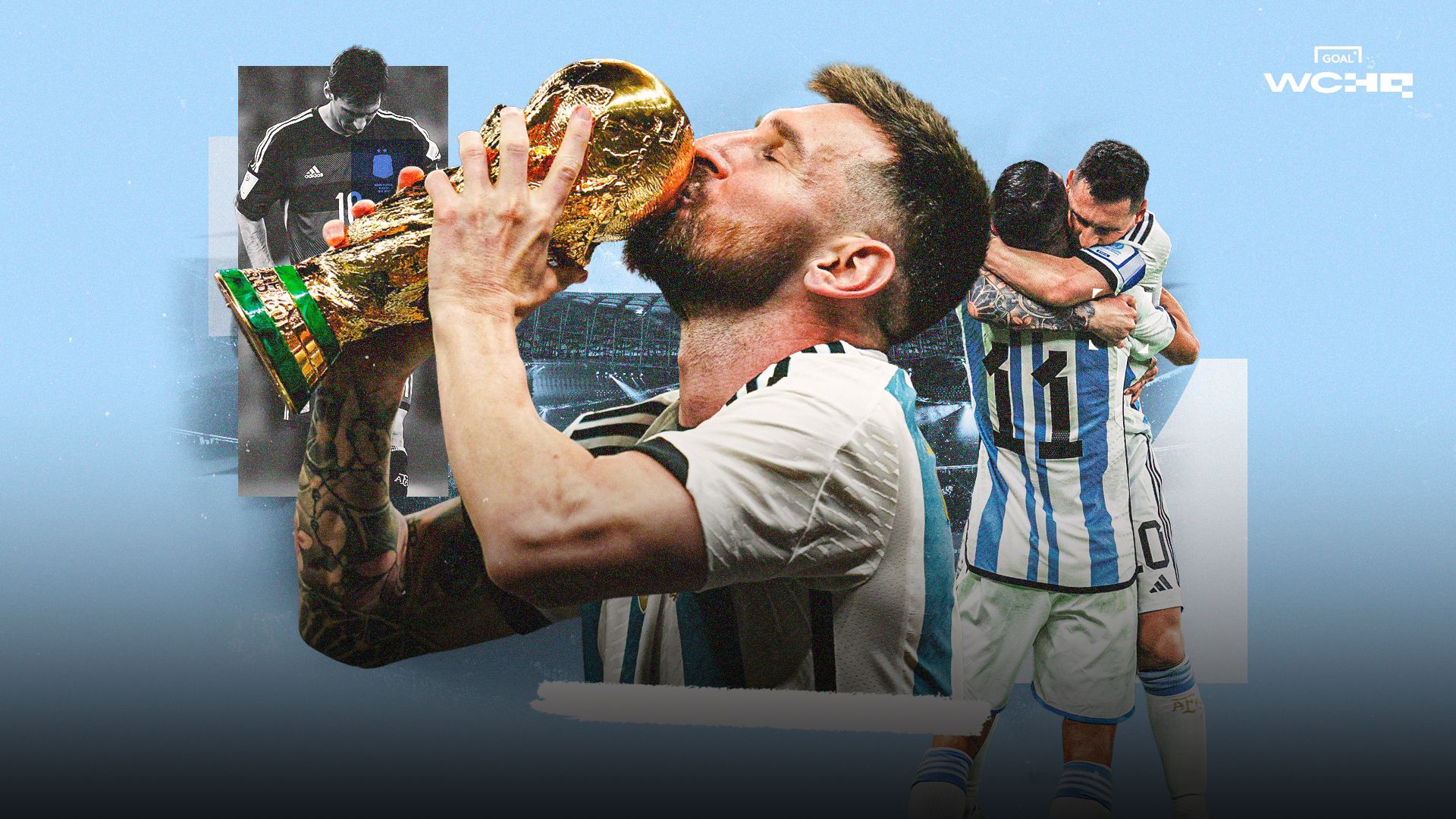
This isn’t a story of perfection, or anything close to it. Argentina’s 2022 World Cup actually began about as shockingly as possible. For a while, it seemed the trip to Qatar would be extraordinarily short.Drawn into Group C, Argentina took to the field on the third day of the tournament. To start, they would take on Saudi Arabia. A manageable game, at least on paper, one that gave Argentina a chance to ease into the tournament before taking on tougher challenges.To understand the environment of that game, you have to understand the dynamics. Argentina, more than any other European or South American team, had arrived in Qatar with a massive travelling support that outnumbered the opposition in virtually every match. But not on that day at the Lusail Stadium. Saudi Arabia, as with other regional countries in the tournament, turned up in huge numbers, too.It started well enough for Argentina, who were massive favorites due to a 36-game unbeaten run. Messi scored a penalty in the 10th minute, starting the tournament on the right foot with his trusty left foot. With the pain of 2014 and 2018 still on everyone’s minds, that was an early sign that things could be different, that Argentina were up to the challenge. On this particular day, they weren’t, though.Saleh Al-Shehri scored three minutes after half-time to stun the Argentines. Five minutes after that goal, the ball was in the back of the net again via Salem Al-Dawsari. It finished 2-1. It was more than disappointment; it was disbelief."There's no other choice but to get up and move on,” Argentina coach Lionel Scaloni said after arguably the biggest upset in World Cup history. “We don't have to analyse more than that. Today is a sad day, but we have to raise our heads and keep going. Before the game, they made us the favorites, but in a World Cup these things can happen."It was already make or break for the footballing heavyweights, though, and Messi knew it. "It is a moment to be more united than ever,” the skipper said. “We did not expect this, but it's on us."History made it quite clear what Argentina would need to do next. Historically, World Cup group winners average about seven points. Second-place finishers average around five. With only six points left on offer, Argentina now needed to defeat both Mexico and Poland, widely seen as their tougher opponents in the group stage. The margin for error vanished, meaning set in just as the tournament was beginning.As time ticked in the second half, you could feel the tension in Lusail. The match itself, one between Argentina and Mexico, had undertones of a historic rivalry. As the match wore on, though, all of that mattered little. This was now about survival.Midway through the second half, the two sides found themselves level at 0-0. Following Poland's win over Saudi Arabia earlier in the day, both sides were aware of the stakes. A draw would make things difficult. A win? That would give them a chance. So, who would step up? Take a guess.With 64 minutes gone, Messi found a way, and he found it out of nowhere. It all seemed harmless enough as he drifted to the middle of the field until, suddenly, the ball was at his feet. From there, in the blink of an eye, it was in the back of the net - and Argentina were off sprinting after their skipper, celebrating a turning-point goal.With just minutes remaining, one of the tournament’s youngest stars announced himself to the world. In need of a goal to seal the victory, Enzo Fernandez provided it, establishing himself as the present and future of Argentina’s midfield. It finished 2-0, with three points to Argentina, who were back on track."It's a weight off our shoulders," Messi said. "We have peace of mind and it's back in our hands again."In the group stage finale against Poland, the supporting cast stepped up. Alexis Mac Allister and Julian Alvarez each scored in the second half, solidifying Argentina's improbable place as group winners. They survived a scare and, in the process, perhaps hardened themselves for the battles to come.There have been better World Cup matches than Argentina's clash with the Netherlands. However, few have been more eventful.After knocking Australia out in the Round of 16, Argentina were matched up against a European heavyweight. What ensued was 120 minutes of pure chaos. Late goals, bench-clearing brawls, personalised taunts, a rollercoaster shootout - the match had it all and, afterwards, it was rather appropriately dubbed 'The Battle of Lusail'.On either side of an 88th-minute fracas prompted by Leandro Paredes booting the ball directly at the Dutch bench, there was some pretty good football played, too. Nahuel Molina scored shortly before half-time for Argentina from an outrageous assist from Messi, who made it 2-0 from the penalty spot in the 73rd minute.The Dutch fought back, though, with the hulking Wout Weghorst showing finesse to score two late goals, including one in the 11th minute of stoppage time. Extra time provided no winners so penalties it was, and, once there, Argentina outlasted the Netherlands.Tensions didn't cool after the whistle, as Messi snapped at Weghorst with his now-infamous "¿Qué miras, bobo?" ("What are you looking at, fool?") quip before taking aim at Dutch coach Louis van Gaal. The Dutch boss had famously criticised Messi and Argentina, most poignantly saying that Messi was not a team player. On this day, Messi and his team got the last laugh, and the normally stoic Argentine uncharacteristically fired back."I feel disrespected by Van Gaal after his pregame comments and some Dutch players spoke too much during the game," Messi admitted. "I heard Van Gaal saying 'We've got an advantage on penalties, if we go to penalties we win,'" goalkeeper Emilinao Martinez added. "I think he needs to keep his mouth shut."Even months later, the bad blood remained as Van Gaal, who resigned after the match, went on to accuse FIFA of fixing the game for the Argentines. All that mattered for Argentina, though, was that they were through.A Messi-inspired 3-0 win over 2018 World Cup finalists Croatia in the semi-finals set up a date with destiny. Messi vs Mbappe, Argentina vs France - it was the biggest game featuring the biggest stars on the biggest stage.Finals rarely live up to expectations. They’re often tepid, cautious affairs featuring two teams afraid to lose, particularly in the World Cup. That wasn’t what Argentina and France provided, though. They delivered a classic, the greatest final ever played.There was the early penalty from Messi and then the brilliant breakaway finished by Angel Di Maria. There was Kylian Mbappe's famous response, scoring two goals with the clock winding down. There was Messi's apparent extra-time winner, only for Mbappe to reply with two minutes to go to complete only the second hat-trick in World Cup final history.Even then, though, the drama wasn't done. After all, who could possibly forget Martinez’s heroic, last-second save from Randal Kolo Muani, perhaps the best the sport has ever seen? It was a true title fight, one that pitted the sport's past against its future - all for the right to control the present.In the end, it wasn't decided by Messi or Mbappe, as both converted their spot-kicks to commence the shootout. Instead, it fell to their supporting cast.Messi's side stepped up, seemingly willed by their desire to do it for their leader. Mbappe's side, meanwhile, floundered, missing two straight penalty kicks to give Argentina a clear path to victory.The Albiceleste sprinted right on down, with Montiel the man positioned to be the unlikely hero to seal Argentina's third World Cup. Before that penalty, Messi could be seen whispering to himself: "Puede ser hoy, abu" (“It could be today, grandma”). Many in the crowd could be seen looking towards the sky, too.Some were calling on the almighty Maradona. Others were remembering relatives and friends they’d lost along the way. For many, a lifetime of memories boiled down to one moment and one kick. That kick from Montiel was perfect. The ball rolled directly into the net and, as it struck, Messi collapsed to his knees.The prayers had been answered, not just for Messi, but for millions all over the world.The 2022 World Cup will be remembered for many things and, of course, the tournament’s legacy is somewhat complicated. Yes, it was, as most World Cups are, a moment of unity. It was an unprecedented event for the Arab world, which welcomed the beautiful game into the region. Many fans will never forget Morocco’s historic run, and the roar of the crowd.Yet this was not a World Cup without controversy. Human rights discussions, for many, overshadowed what was - at least on the field - a fantastic tournament. The bidding process was marred by allegations of bribery, and the high number of migrant worker deaths that occurred during stadium construction led many to protest FIFA’s decision to hold the tournament - pushed back later in the year because of the heat - in Qatar.Some will find success stories elsewhere. There were more goals scored (172) than at any previous World Cup. According to FIFA, 3.4 million people attended the games, and the four-year cycle to 2022 was the most lucrative ever, generating $7.5 billion ($5.5bn). Infantino would go on to describe the tournament as "the best ever" because of the "unique, cohesive power that this World Cup has shown."From a purely soccer perspective, though, there’s one defining moment. It came seconds after the match when one of the game’s all-time greats had finally realised his dream. Messi had accomplished seemingly all there was to accomplish. He had effectively completed football.But the moment he got his hands on that World Cup trophy, everything else seemingly disappeared. It was at that moment that his legacy was fully formed. It was at that moment that Messi finally did what he had always set out to do: make his country proud.It wasn’t just Argentina that celebrated that fact. Messi has long been a defining figure in the sport, one who has transcended the game itself. With his performances in Qatar, he became, almost impossibly, something even bigger.Lifting that trophy with fireworks blasting behind him, he became more folk hero than man, more symbol than athlete. He was undeniable. “I dreamt of this so many times,” he said. “I can’t believe it.”The party continued as Argentina moved all over the field. Sergio Aguero, one of Messi’s best friends and most trusted teammates, was welcomed to be a part of the celebration, despite missing out on the tournament. A heart issue had ended his career, but it wouldn’t prevent this moment of joy.And so it was Aguero who hoisted Messi onto his shoulders and presented him to Argentina’s fans. There Messi sat, World Cup trophy in hand, smiling ear to ear. Through it all, a song rang out. “Muchachos,” the fans sang over and over again.“Guys, now we're excited again,” came the full-throat sound. “I want to win the third, I want to be world champion! And Diego, in heaven, we can see him, with Don Diego and La Tota, encouraging Lionel!”

.png)
Most Popular


RCB - Increasingly at home in the Chinnaswamy
5 hours ago

Cummins set for IPL return
4 hours ago