
VAR, Messi and World Cup's consistency crisis

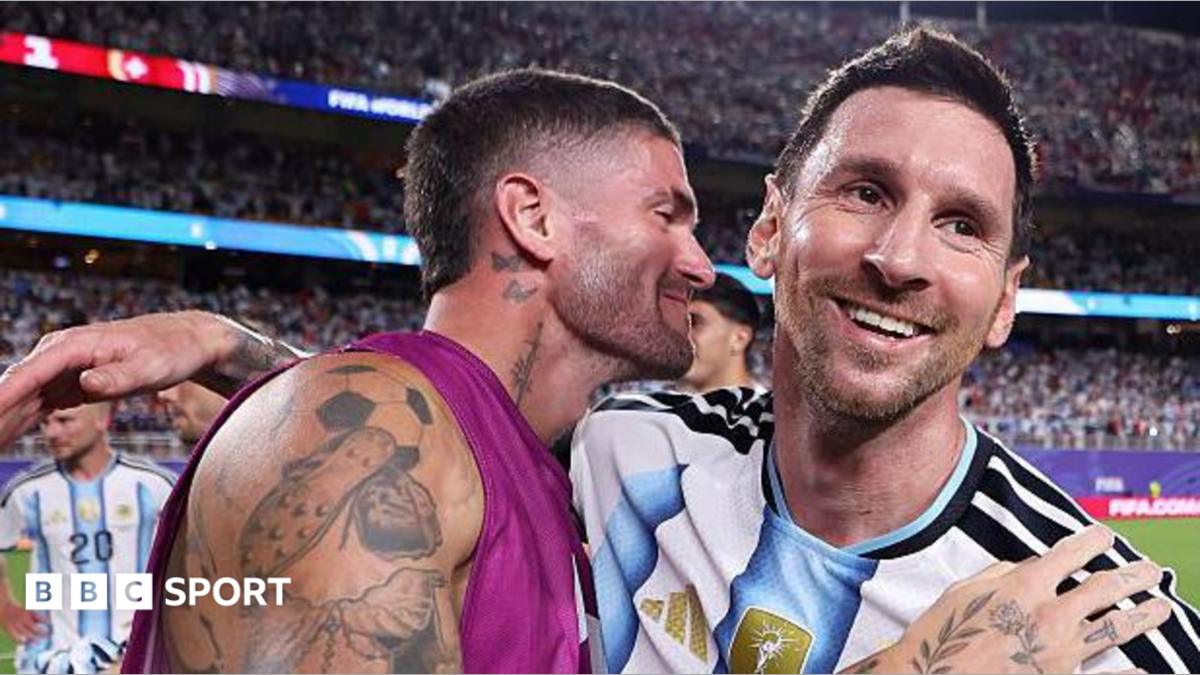
England against Argentina should never need another storyline.A World Cup semifinal between two nations stitched together by history ought to be about Jude Bellingham's rise, Lionel Messi's pursuit of one last crown and the latest chapter in one of football's most enduring rivalries.Instead, on the eve of tonight’s battle at Atlanta Stadium, the conversation has drifted elsewhere. Not to tactics, not to team news. To VAR (Virtual Assistant Referee).The technology introduced to eliminate controversy has become the tournament's defining subplot, and Argentina, fairly or otherwise, have found themselves at its centre.For Lionel Scaloni, the accusations have become as inevitable as they are tiresome.Asked once again whether his side had benefited from officiating decisions, the Argentina coach dismissed the claims as little more than social media noise."Since VAR arrived, there is no possibility of favouritism," he said, urging his players to embrace the scrutiny as a compliment rather than a burden.His frustration is understandable. So, too, is the scepticism.Not because there is compelling evidence that Argentina have received preferential treatment, but because this World Cup has exposed a more uncomfortable reality.Nearly every major refereeing debate has revolved around the same question: not whether VAR reached the correct decision, but whether anyone still understands when it chooses to intervene.That uncertainty has followed the tournament from the group stage to the semifinals.Against Egypt in the round of 16, Argentina completed a remarkable comeback after Mostafa Zico's goal was ruled out following an exhaustive VAR review that travelled back through the attacking possession phase to identify an earlier possible misconduct. The decision was defensible under the laws of the game. Yet it also became the clearest example of how far the technology is now prepared to rewind play in search of an offence.Elsewhere, Croatia were left questioning the microscopic offside decision that ended their campaign against Portugal. Germany exited amid controversy over a disputed corner-kick decision.Across the tournament, similar challenges have produced different disciplinary outcomes, while some incidents have prompted painstaking reviews and others have escaped examination altogether.Individually, none of those decisions proves systemic bias.Football has always lived with contentious refereeing decisions. What it struggles to accept is unpredictability. If one incident demands a forensic investigation stretching back through multiple phases of possession while another, apparently comparable, receives barely a glance, fans inevitably begin questioning not just individual decisions but the consistency of the process.Justice depends on more than reaching the correct verdict. It depends on applying the same standard every time.That inconsistency is not confined to Argentina's matches. Yet Argentina remain where the debate always seems to arrive in full force.The contrast was telling in the quarterfinal against Switzerland. Breel Embolo's dismissal after VAR applied football's new mistaken-identity protocol sparked fierce debate, with Swiss coach Murat Yakin questioning the law itself.Yet only days earlier, Paraguay's Miguel Almiron had been dismissed in almost identical circumstances against the United States under the same protocol.The law was the same. The discussion was not.Likewise, Croatia's frustration over offside decided by millimetres, Germany's complaints about VAR intervention and Egypt's anger over the disallowed goal all reflected the same underlying concern: supporters no longer know where intervention begins or ends.The VAR apparently is creating more problems than it is solving.So why has Argentina become the face of the controversy? The answer may have less to do with officiating than with the man wearing No. 10.Football has never known another player quite like Messi. Every challenge involving him is replayed endlessly. Every refereeing decision in Argentina's matches is dissected across television studios, podcasts and social media.When Messi escaped further punishment after catching Algeria’s Aissa Mandi with his studs during the group stage, the debate quickly expanded beyond whether it merited a red card. It became another argument about FIFA, officiating and the credibility of the competition itself.Had the same challenge involved a less celebrated player in a less glamorous fixture, it is difficult to imagine it carrying the same aftermath.That is the Messi factor. It does not prove favouritism. It guarantees scrutiny.The irony is that Messi may not be creating football's crisis of legitimacy. He is simply exposing it to the widest possible audience. The inconsistencies that have surfaced throughout the World Cup become impossible to ignore when they unfold around the sport's biggest star.VAR was introduced in pursuit of perfect justice. Instead, it has revealed that justice is about more than technology or technical accuracy. It is about trust. Once confidence in the consistency of the process begins to erode, every contentious decision becomes evidence for whichever narrative supporters already believe.And perhaps that is why every road in this World Cup's refereeing debate seems to lead back to Argentina. Not because every controversy involves Messi, nor because every complaint is justified, but because every incident involving football's biggest star inevitably becomes a wider debate about the credibility of the game itself.

Most Popular


Tuchel: 'We want to take the next step'
3 hours ago

World Cup 2026: England v Argentina semi-final
6 hours ago