FIFA World Cup Classic Clashes - Ghana vs Uruguay, 2010 in South Africa
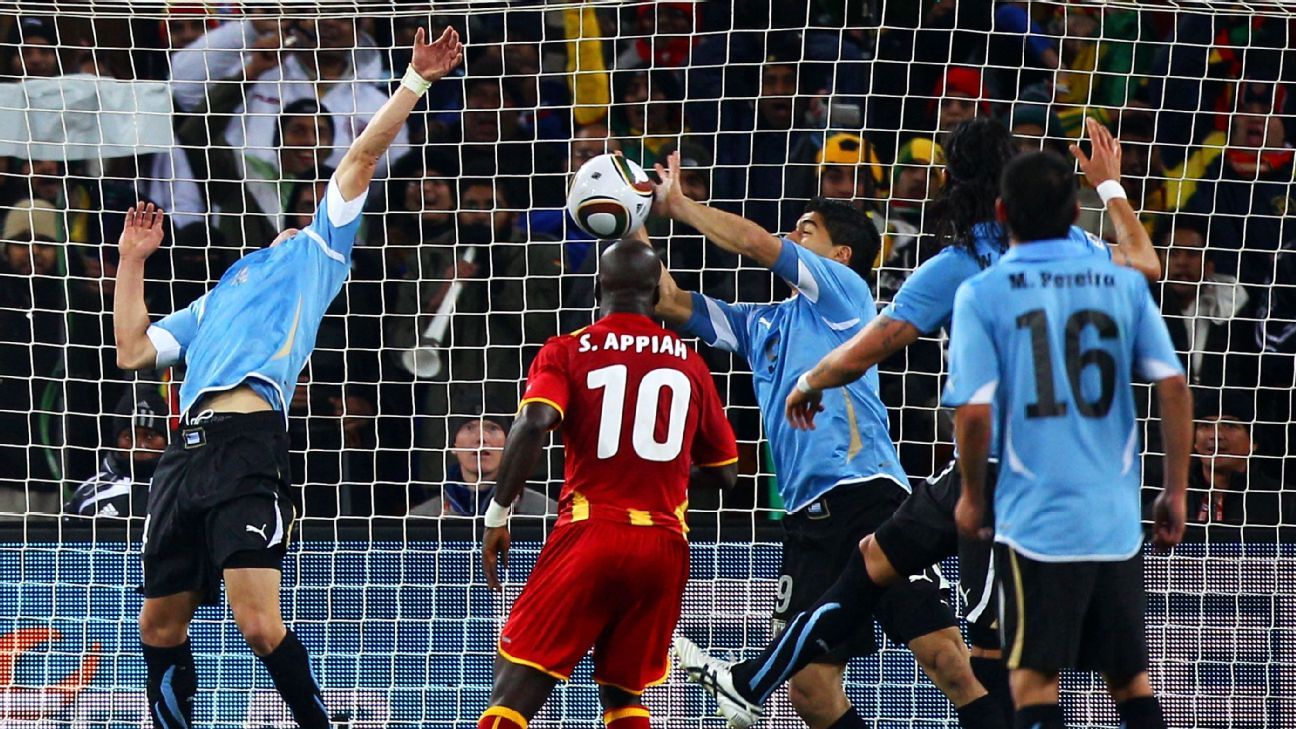
There are FIFA World Cup matches that people remember, then there are the matches people carry with searing pain in their hearts. For Ghana, July 2, 2010 remains both.Even now, any mention of Soccer City in Johannesburg brings a flood of emotions running through Ghanaian hearts. A combination of pride at what might have been, anger at what was not, disbelief at how it even happened at all, and heartbreak at the way it went down.The Black Stars were just one kick away from becoming the first African team to reach a FIFA World Cup semifinal, and on African soil to boot. Instead, it became part of one of the tournament's most controversial and painful nights.The SceneThe 2010 FIFA World Cup was already historic before Ghana reached the quarterfinals. It was the first World Cup held on African soil. It was also the first to have the most African teams in history (at the time), with a total of six.By the time Ghana faced Uruguay, the Black Stars had become the continent's last remaining team. South Africa, Nigeria, Cameroon, Algeria and Ivory Coast were all gone.As they carried Africa's hopes alone, South African fans duly adopted the Black Stars as their own, naming them "BaGhana BaGhana", a nod to their own team's "Bafana Bafana" nickname.Milovan Rajevac's side had earned that status the hard way. They beat Serbia in the group stage, drew with Australia and Germany, then defeated the United States 2-1 after extra time in the Round of 16 on the back of another decisive Asamoah Gyan goal.Inside Soccer City, the atmosphere before kickoff felt less like a neutral World Cup match and more like a continental mission. Sandwiched between South African journalist Robert Marawa and Ghanaian counterpart Michael Oti Adjei, I could feel the electricity in the charged atmosphere among the 84,017 who packed the stadium that night.The MatchThe match itself delivered everything football can produce.Uruguay entered with Diego Forlan in superb form and Luis Suárez emerging as one of the tournament's most dangerous forwards. Ghana countered with athleticism, pace and belief.The breakthrough came deep into first-half stoppage time.Sulley Muntari, operating from midfield, drove forward and unleashed a left-footed shot from long range. Fernando Muslera misjudged the strike and the ball flew into the net. Ghana led 1-0.Africa erupted.It took Uruguay just 10 minutes after the break to respond. Forlan curled a free kick beyond a helpless Richard Kingson to level the match at 1-1.From there, the tension became suffocating. But there were to be no further goals in regulation time.Ghana looked the more dangerous side late in the game, Kevin-Prince Boateng coming close with a header in the 118th minute, and it was still Ghana who looked more dangerous again in extra time. Stephen Appiah and Dominic Adiyiah both forced key saves. Uruguay survived, but barely.Then came those infamous final seconds...The ControversyWith the match seconds from penalties, Ghana won a free kick. John Paintsil swung the ball into the box. Uruguay failed to clear cleanly.As the ball bubbled around in the box, Stephen Appiah's close-range effort was blocked on the line by Suarez. The rebound fell to Adiyiah, whose header appeared destined for the net.But Suarez intervened, this time illegally, throwing both hands upward to fist the ball away.Referee Olegario Benquerenca immediately awarded a penalty and showed Suarez a red card for denying an obvious goal-scoring opportunity.It was Ghana's moment to make history. Up stepped Gyan, Ghana's most reliable goalscorer and penalty taker. He had already scored three goals in the tournament, converting penalties against Serbia and Australia earlier in the World Cup. Ghana trusted him completely.One kick would send Africa into its first World Cup semifinal. Suarez on his way to an early shower, stopped in the tunnel to watch.Gyan's shot was as powerful as it was well-struck. The only thing missing was precision. The ball cannoned off the underside of the crossbar and out.The cameras caught Suarez celebrating wildly in the tunnel as Ghanaian and African stomachs churned."It would have been very fair for us to win that game," Gyan later told FourFourTwo. "Unfortunately I didn't convert."The match went to penalties.Like Zico at the 1986 World Cup, who missed a penalty in regulation time that would have won the game for Brazil against France, but went on to score in the shootout, Gyan recovered enough to score Ghana's first kick.But, like that Brazil team, Ghana lost out, when misses from John Mensah and Dominic Adiyiah handed Uruguay a 4-2 victory after Sebastian Abreu chipped home the decisive Panenka.However, unlike Zico, who was playing the last game of his career, Gyan had more to lose and he later acknowledged that scoring first in the shootout that night was what saved his career.He said: "If I had not taken that penalty, that would have been the end. Because the initial one that I missed affected me. Looking at the time I missed the penalty, there was no other option to redeem myself."As for Suarez, he remained defiant and never apologized for the handball: "It was worth being sent off. At that moment there was no other choice."Uruguay coach Oscar Tabarez also defended his striker after the game."When he handled, he didn't know Ghana would miss the penalty," Tabarez said.From Uruguay's perspective, Suarez sacrificed himself for his country. From Ghana's perspective, It looked like he stole their history.The emotional fallout lasted years. For Gyan, the hours and years that followed were their own kind of torment. In a conversation with former Manchester United and England defender Rio Ferdinand, Gyan revealed the first thought that hit him after the miss."I let Africa down," he told Ferdinand. "At the back of my mind, I was hearing voices saying don't shoot. But I was the team's penalty taker, so I had to step up.""Till today, any time alone, it still haunts me," he told TV3 Ghana. "Sometimes I feel like the world should go back again so I can redeem myself, but I know this is something that will haunt me for the rest of my life.""People still abuse me for my penalty miss," he told FourFourTwo in 2026.In Ghana, Suarez became public enemy No. 1. Yet Gyan also said he understood Suarez's decision: "If I had been Suarez, I would have done the same thing to save my country."Not that that perspective softened the pain in any way for Ghanaians, not just because the Black Stars lost but because of how close they came.The Twist in the TailThere is another layer to the story that has gained more attention in the VAR era. Most people who watched that night in Johannesburg have spent 15 years believing Ghana were robbed by a handball. But recently, that story has become slightly more complicated.Referee analyst Victor, who operates the Referee Channel on social media and has more than 12 years of experience as an active referee and instructor, conducted a detailed frame-by-frame review of the final seconds of extra time and concluded that the entire sequence should never have reached the point of Suarez's handball.His finding: Stephen Appiah was in an offside position when the ball was headed to him from the free kick, just moments before Suarez handled on the line."Before the handball offense, the ball came from a free kick. When the ball was headed to number 10, he was in a clear offside position," Victor said, maintaining that the missed call fundamentally altered the sequence of events.The implication is that a correct offside decision would have resulted in an indirect free kick to Uruguay, preventing both the handball and its consequences.He added: "Had he spotted this offside offense, Suarez would never have been sent off. So this was an incorrect decision in this match."Under modern VAR protocols, the offside would have triggered an automatic review before the penalty was taken. If offside had been confirmed, play would have stopped before Suarez's handball became punishable. The match would still have gone to a shootout, but with Suarez on the pitch.That would have changed everything. No penalty. No red card. No villain moment for Suarez. No infamous career-defining miss for Gyan.One of the most replayed incident in African football history might never have happened at all.The ConclusionAfrican teams have produced strong World Cup runs before and after 2010. Cameroon reached the quarterfinals in 1990. Senegal did it in 2002. Morocco finally broke through to the semifinals in 2022.But Ghana's run in South Africa still occupies a different emotional space because it happened in Africa and it ended what could have been a storybook moment, not just for the Black Stars, but for the continent.One minute, history was there for the taking. Then suddenly, it wasn't. And for Ghana, it is a heartache that will never go away.


Most Popular