
“We want to build a powerhouse”: Anudeep Reddy leading India’s lacrosse rise ahead of LA28 and beyond
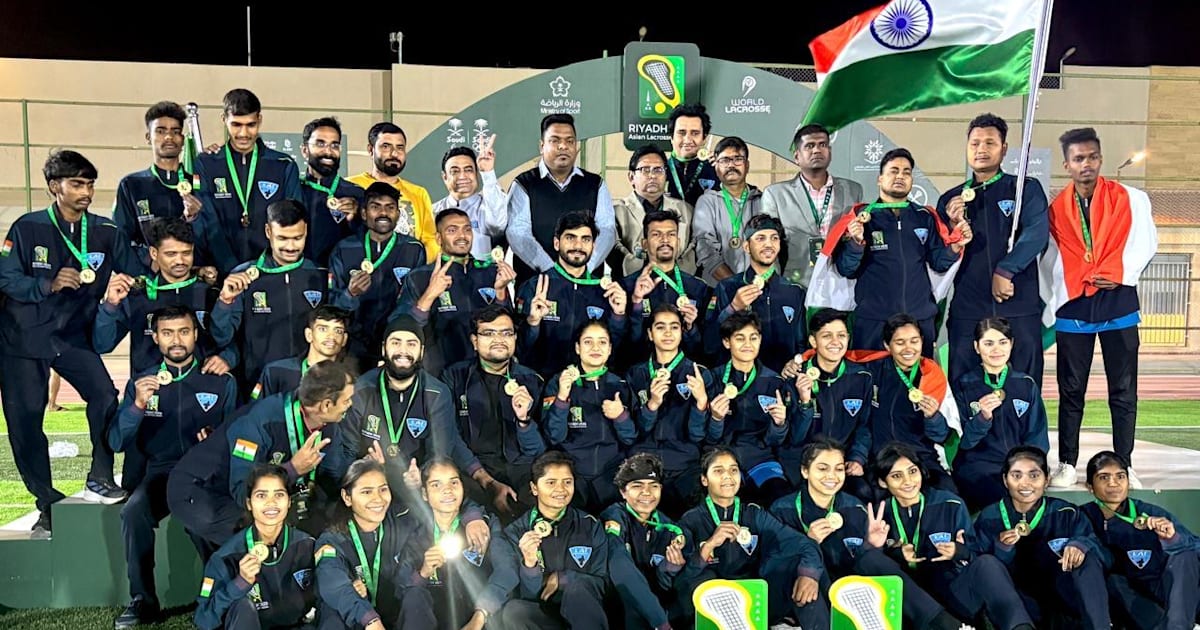
We often hear stories of Olympic dreams born early, sparked by watching a star on television and dreaming of one day reaching that stage.Rarely do we hear of a dream not just to reach the stage, but to help build the stage itself.India’s Anudeep Reddy is a law student, former hockey player, and chess enthusiast with a strategic, ever-curious mind. Always looking to stimulate that mind, Reddy was on the hunt for his next challenge.“I was bored one day and began searching for new sports that are part of multi-sporting events like the Olympics and Commonwealth Games,” he told Olympics.com in an exclusive interview. “That’s when I came across lacrosse.”“The Olympics are the biggest stage for any athlete,” he said. “That was one of the main motivations for me to take up the sport.”With a background in hockey, the transition felt natural. “The stick skills are pretty similar,” he explained. Within six months, Reddy had earned a place on the national team, and from there, “there was no looking back”.Just three years after first picking up a stick, he has already led India to a historic Asian Lacrosse Games victory.On the eve of another 2026 Asian Games campaign, Reddy and India’s men’s and women’s teams return to the stage with a triple mission: to defend their titles, edge closer to LA28 Olympic qualification, and grow the sport at home for future generations.A sport built by players, for playersBeyond the prospect of becoming an Olympian, Reddy saw a rare opportunity in lacrosse: to shape a sport from scratch.India, he said, already has a deeply rooted sporting culture, with cricket, football, and hockey operating in well-established systems.“So if you get into an emerging sport like lacrosse, you can actually build the system from the ground up and bring players in from the grassroots level. You can make a much larger impact compared to trying to get into an already established system. We're trying to build a system wherein India actually becomes a powerhouse in a couple of years.”The progression, much like the game itself, was fast.Lacrosse was first introduced in India in 2008, led by Bijay Mipun, considered the “father” of Indian lacrosse. But it wasn’t until players like Reddy took it up around 2020 that the sport began to gain real momentum. India joined World Lacrosse in 2021.“The Lacrosse Association of India [LAI] has given us a lot of freedom, especially in terms of suggestions as well as developmental activities,” Reddy said. “So I have to thank them for being flexible and giving players the chance to grow the sport.”It has not come without challenges. Reddy admits it took “a lot of explaining” to introduce the sport to those unfamiliar with it.The players themselves have also had to take on multiple roles, as coaches, mentors, and even referees at times: “Because it’s all new, the players have to wear multiple hats. We spend on average five to seven days every month trying to promote the sport.”In fact, it was Reddy himself who reached out to Olympics.com, wanting to share their story on one of these five to seven days.Reddy: “The diversity that we have is one of the biggest strengths”Their story is one of many colours.The team is made up of players from all across India, a mix of cultures, regions, and languages.“India is like a continent,” he explained. “It's a very big country, so we have players coming from eight to 10 different states that are part of the national team. Each national player is around 500 or 600 miles apart, so we don't train together often. When we do, we train together for around 10 to 15 days.”The scale of that diversity is represented in the team itself.“Even within the team, the 12 players speak around eight to 10 different languages. Usually, we communicate in English and Hindi, those are the two main languages. But in a team setting, it’s a lot of fun, especially when a new player comes in. They’ll speak in their own language, and we try to get them to speak English or Hindi.”“It’s actually an icebreaker,” he said. “When new players come in, we start talking, having conversations, and it becomes a lot of fun. Even though we are a very diverse team, we bond very quickly and have a lot of unity.”“I think the diversity that we have is one of the biggest strengths of our nation,” Reddy said.Despite the distances, the connection remains constant. Reddy says the players stay in touch through group chats, messaging each other “pretty much every day”.Hard work pays off: Indian history at the Asian Lacrosse GamesAfter just three years in the sport, Reddy captained the team at the 2024 Asian Lacrosse Games in February this year, an event originally scheduled to take place in Saudi Arabia in 2024 but later moved to 2026.It marked their first-ever international tournament in lacrosse sixes, one of three formats alongside field and box, and the version set to feature at LA28.Before that, the team had competed in one field lacrosse international tournament, the Okinawa Open, despite having never played with field lacrosse equipment. Field lacrosse uses long sticks for certain positions, while Reddy and his teammates had only ever played with sixes sticks, which they received in 2023.“We had never played with long sticks before that. We never had any equipment, so it was more about exposure, to get on to the field, play, learn, and come back to India to implement what we’d learned. Although we didn’t perform well, we learned a lot.”In Riyadh, they were newcomers once again, facing unfamiliar opponents and adapting to new conditions, including playing under floodlights for the first time after training exclusively during the day. “It was all new for us,” he said, another steep learning curve.They lost their first game against Saudi Arabia, but quickly regrouped and did not drop another match, including the final, where they defeated Iraq 9-2 for the historic title.“It was a great moment, it was historic, especially for India to win the gold across both the men’s and women’s formats in the same tournament. Since we just started playing about three years ago, I think it was pretty historic.”“Hearing the national anthem play after we won, waving the national flag, those moments, I don’t think any player, whether a captain or not, can fully describe it. It’s something you have to experience. And as a captain, it motivates me even more, especially for future generations.”The tournament gave Indian lacrosse a significant boost in visibility, support, and belief.“It gave us the motivation that we belong on the international stage,” Reddy said. “We started getting support from the government, from the media, and from the audience. That’s how a sport builds and becomes stronger.”It did not hurt, either, he added, that the Indian women’s team defeated Pakistan 22-5 in the final, a rivalry that always draws attention.A strategic mind in a strategic sportReddy admits that his approach to lacrosse is shaped in large part by his background in chess, something he says is “in my veins and blood”. By his own estimate, he uses that mindset “30 to 40 per cent of the time”. A precise estimation, indeed.Like any strong chess player, Anudeep thinks long term, always with the endgame in mind.“The moment I realised it’s not about my personal achievements or personal success, but more about building a system and building the sport for future generations, that’s when I decided I had to pursue this sport much more seriously,” he said.“You’re building a movement for lacrosse in a way. You’re building something for the next 10 or 20 years, rather than just for yourself.”He believes building that movement and closing the gap with more established nations comes down to two key areas: infrastructure and exposure.“To bridge that gap, we need to get more international exposure and more infrastructure in India. We have to participate in all the international tournaments and go on international camps, as it gives us more tactical understanding from an outside perspective. Apart from that, if we could have more manufacturers in India in-house, it could get down the cost of lacrosse.”He also pointed out that, given how new the sixes format is globally, there are limited resources to learn from. To fill that gap, he turns to content from Paul Rabil, co-founder and president of the Premier Lacrosse League, as well as studying game footage from the PLL itself.Reddy or not, here they comeStarting tomorrow (21 April), Reddy and Team India return to the Asian Games stage for the 2026 edition in Chengdu, aiming to defend their titles in both the men’s and women’s competitions.The upcoming Games, he believes, will be “tougher” than the last, with more nations competing this time around.“In the Asian scene, some of the stronger teams include [People’s Republic of] China, Hong Kong, and the Philippines. If you look at the Asia-Pacific region, Australia is very strong, and New Zealand is an emerging nation in lacrosse. Singapore is emerging too. Although sixes is still new internationally, these nations have a lot of experience in field lacrosse, and many of those skills overlap, which gives them an edge over India.”Still, the approach remains simple: “We’ll give whatever we can and do our best out there.”Beyond Chengdu, the bigger picture is already in focus: LA28.Continental tournaments will play a key role in Olympic qualification, influencing rankings and progression to the 2027 World Lacrosse Sixes Championships, the main qualifying pathway.From there, four teams per gender qualify directly for LA28, with the remaining spots decided at a final qualifying tournament, bringing the total to six teams per gender.“We definitely have belief. The time is short, but whatever is in our control, we’re trying to improve and work on it. That’s the short-term goal. If not LA28, then Brisbane 2032, or even 2036.“As I said, we’ve only been playing lacrosse for three years.”

Most Popular


Seed Tritons Set for Postseason Rematch
2 hours ago