Brazil vs Morocco EXPLAINED: Impressive Morocco secure a point against an underwhelming Brazil team
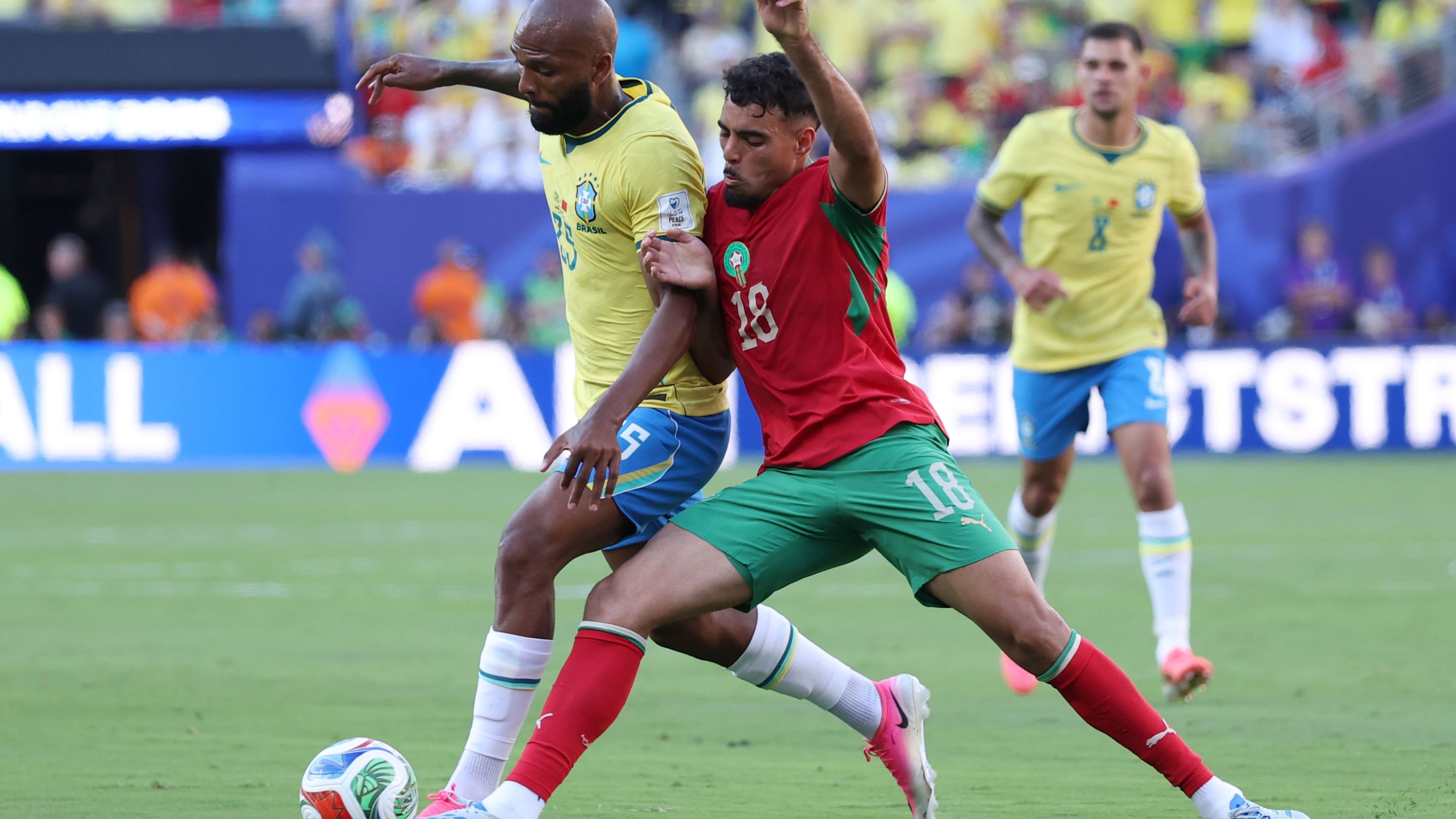
The 1-1 draw between Brazil and Morocco was a fascinating battle between a side built around elite individual quality but lacking cohesion against one of the most organized collective teams in international football, albeit inferior to Brazil quality wise.Brazil lined up in a 4-2-3-1 with Allison in goal, with a back four consisting of Ibanez, Marquinhos, Gabriel, Santos. A midfield pivot of Casemiro & Guimaraes was behind a front four of Paqueta, Raphinha, Vinicius with Thiago leading the line.Morocco lined up in a 4-2-3-1 with Bono in goal, Mazraoui, Riad, Diop, Hakimi in the backline. Aynaoui, Bouaddi & Ounahi played in midfield with a frontline of El Khannous, Saibari & Diaz.Dominant first 30 minutes from Morocco left Brazil in shockMorocco came into this tie as the underdog with Brazil as the heavy favorites on paper, but in the opening period of the game, Morocco immediately looked to stamp their authority with lightning quick transition play and a compact aggressive mid block when they were defending which eventually led to their opener.Morocco’s impressive youngster Bouaddi in particular was the star of the show as he pulled the strings in midfield with an all action display both in and out of possession.Morocco defended primarily in a compact 4-4-2 mid block shape, keeping minimal distances between their midfield and defensive lines.SubstackRather than pressing Brazil aggressively high up the pitch, Morocco focused on protecting central areas, blocking passing lanes into Brazil players operating centrally, triggering pressure when Brazil played backwards and most importantly forcing circulation towards the flanks intelligently.The latter tactic eventually led to Morocco taking the lead as they managed to funnel Brazil’s build up into their left hand side before winning the ball after intercepting a failed wide combination play from Brazil, before playing quickly to find Diaz who played a through ball between Marquinhos & Gabriel to find Saibari through on goal to put Morocco ahead in the game.It was a well deserved lead that showcased how Morocco could transition quickly from back to front in a matter of seconds after regaining the ball.Error strewn Brazil struggled to impose themselves both in and out of possessionBrazil’s biggest issue was not ball retention but progression. Midfield cohesion was lacking as they struggled to build up and progress the ball cleanly on multiple occasions.Brazil looked to build up in a 3-2 shape with a back 3 of Santos, Gabriel & Marquinhos in the first line of build up as Ibanez was tasked with operating higher on the second line. The shape itself wasn’t the issue but instead the problem was that the distances between Brazil’s midfielders and forwards were often too large.SubstackIn possession Casemiro & Guimaraes anchored the midfield but they often struggled when attempting to build up and progress play cleanly from back to front. This resulted in cheap ball losses in deep build up and a failure to break lines effectively which resulted into the early struggles Brazil faced.Out of possession, Brazil’s defensive structure was also a mess as they were consistently pulled apart by Morocco’s fluid possession game with Brazil’s midfield often caught chasing shadows repeatedly. Gaps repeatedly appeared in Brazil’s structure that the midfield duo struggled to cover both centrally and laterally which highlighted both a tactical and personnel issue simultaneously.Casemiro’s struggles in particular were painfully evident as he seemed to have lost a yard of pace physically before being replaced by Fabinho at the start of the second half. By this time it was clear that Ancelotti had clocked Brazil’s weakness in personnel both in midfield and fullback areas with his early double substitutions, as these were areas Morocco specifically targeted against them.Vinicius’s individual brilliance masked Brazil’s final third strugglesBrazil lacked a facilitator in the final third for any of their attacks to be effective so it was actually not a surprise that a lot of their attempted attacking patterns consistently broke down before materializing into anything potentBy facilitator I mean a connective presence capable of linking midfield to attack, receiving under pressure, combining with teammates, and activating the wide movements of Vinicius & Raphinha, who are two of the best breakers in Europe. Too often attacks broke down because there was no player consistently performing that role.Igor Thiago for all his strengths as a striker isn’t that sort of profile as he’s a classic target man who waits to be served, rather than being a maverick type forward that looks to connect the pieces together in the final thirdCunha profiles as this sort of forward who could provide that attacking balance for Brazil so it was a surprise that he was not leading the line in place of Igor Thiago, who seems like the sort of profile you bring in second half of games when chasing a lead and looking to load up the box as an alternative tactic.CONCLUSIONFor all of Brazil’s individual quality, the match highlighted familiar problems leading up to this tournament. Their build-up lacked the precision needed to unsettle a compact block, while their defensive structure remained vulnerable after turnovers. Against elite opposition, these shortcomings could prove costly as the tournament progresses.Morocco once again demonstrated why they have become one of the most tactically respected teams in international football at the moment. Their defensive organization, discipline, and transition threat allowed them to compete on equal terms with one of the world’s most talented squads. This was not a lucky draw, it was a carefully executed game plan.
Most Popular