Is VAR Technology ‘Ruining’ the World Cup?
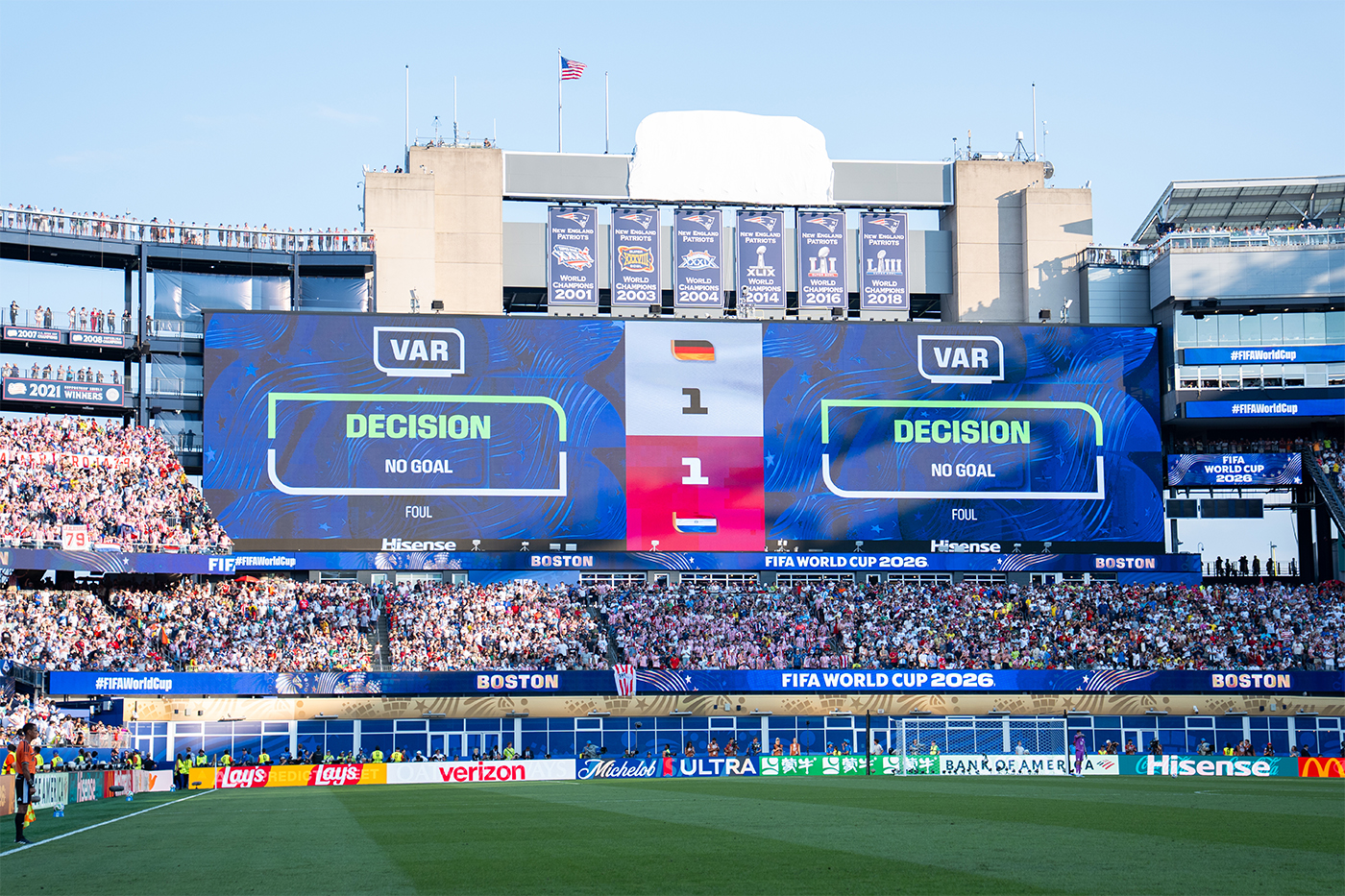
Is technology ‘ruining’ soccer? How advancements have changed the sportThe 2026 World Cup may be the most technologically advanced yet. From player avatars made with AI to video replays to confirm or challenge calls, soccer continues to see advances in technology that has changed the game.In a recent Round of 16 World Cup match, a review by the video assistant referee, or VAR, disallowed what would have been Germany’s game-winning goal over Paraguay because of a foul. Paraguay came out on top in a penalty shootout.Belgium won a penalty kick in extra time after a VAR review and made a comeback against Senegal.And a VAR review played a role in why Team U.S.A. striker Folarin Balogun was issued a red card, keeping him out of the rest of the match against Bosnia and Herzegovina and the next one.Technology has impacted not just soccer in particular, but the world of sports in general – with mixed reviews. An automated system introduced this year to baseball allows players to challenge balls or strikes called by the umpire. For four decades now, American football has redefined what a “catch” is with the advancement of slow-motion replays. And human line judges have been fully replaced by technology that watches for where the ball lands on the court in tournaments like Wimbledon and the Association of Tennis Professionals Tour.This year’s World Cup has been declared the “most technologically advanced World Cup ever,” said Santiago Manso, director of sports verticals for Lenovo, which is FIFA’s official technology partner. Ahead of the World Cup, the two entities highlighted three AI-powered features offered by Lenovo.Fans at home can see the point-of-view from the referees, thanks to a small camera attached to their headsets. The 48 teams also have access to “FIFA AI Pro,” a tool to help teams analyze data and metrics (Lenovo did not say which teams were using the tech to “protect the competitive integrity,” Manso said).Experts say adding technology in soccer can make the sport more accurate – sometimes too accurate – and give fans new vantage points to understand why calls are made.“There’s so much skepticism and controversy around communicating to the audiences what technology can add to the experience of the game,” said Casper Harteveld, professor of game design and associate dean of Graduate Programs and Strategic Initiatives at Northeastern University’s College of Arts, Media & Design. “You have more appreciation of the difficulty and the challenges that players have. That’s where technology can help to make that connection to the players.”One such connection is to help spectators and viewers with calls on the offside rule. That rule bars the furthest active offensive player from being closer to the goal line than the ball and the second-last defensive player when the first player receives the ball. For this World Cup, 3D avatars of players were created in part with AI to help demonstrate to fans why calls were made, such as the offside VAR call against Colombia’s Davinson Sánchez that contributed to the team’s loss against Portugal.To reenact why this call was made, Sánchez’s player avatar was shown next to a neon green line, representing the offside line, which cut across his right toe. This demonstration became something of a meme online because of how narrow the margin was.And while technology may be making the game more accurate, efficiency may need some work, noted Brennan Klein, core faculty at Northeastern’s Network Science Institute who is providing unique insights into World Cup data. He said the computer vision algorithms that reconstruct where players are located when a ball is kicked is “quite good.” Technology proved its usefulness again in a first-ever “mistaken identity” VAR decision, when a human referee accidentally issued a yellow card against the wrong player in the U.S.-Paraguay match.Klein thinks the introduction of AI into soccer is “inevitable” with the increased capture of data points from match play, training and more ripe for analysis. It could pose a question of equity if one team is able to access this tool and another isn’t, he added.At the same time, such technology can interrupt game flow by disrupting the matches to dissect each consequential play. The time it takes to review these calls can lead to frustration, Klein said.“If you go to a match and a VAR decision drags on for too long, there’s a palpable ire that starts to well up in the stands. Especially on complex calls, fans will boo and whistle during the deliberation,” he said. “I think this World Cup, so far, has done a pretty good job at quickly delivering VAR decisions, but the sport still has a ways to go.”VAR was first introduced to the World Cup in 2018. A match official uses video replays in a control room to review or recommend calls, the final decision deferred to the on-field referee. It started with reviews of calls including goals, penalties, offside and mistaken identity. This year, the VAR purview was expanded to also check decisions that resulted in corner kicks and second yellow cards.In addition to VAR, soccer also uses goal-line technology, which uses high-speed cameras to determine if a goal is made and is a side effect of an infamous 2010 World Cup match that saw England lose to Germany after a referee didn’t see England’s goal cross the line. Other uses of technology include a chip embedded in the soccer ball that helps with semi-automated offside technology and chest monitors worn by players to track data for performance and injury prevention.With all these added features, an age-old question reemerges of how humans – or in this case, referees – might be replaced by technology.Ashley Phillips, head coach for Northeastern’s women’s soccer team, said technology serves as an enhancement for officials.“I believe referees will always be needed because they manage far more than just enforcing the rules. They are responsible for controlling the emotions and flow of the game in real time, including handling frustrated players, coaches, and high-pressure moments,” Phillips said.The use of technology has to be a balance, said Stephen Warren, assistant teaching professor in Northeastern’s Communication Studies Department.“The thing that people love about sports is the human element of it. We love expecting the unexpected, and that is because it is played by humans and not because it’s played by machines,” Warren said.When calls are dissected to the literal smallest metric, it can take away the energy from the game and leave players hesitant to celebrate a goal before it is confirmed by technology, said Kuda Muhlauri, who was teaching a private soccer lesson at Carter Field off Columbus Avenue in Boston on a recent afternoon.“If they try to overuse the technology, it ruins the game, in a way,” he said.He generally supports technology to help make objective decisions like offside or diving. But the subjective ones, like red cards for players who cover their mouths while speaking to an opponent, might be better off without technology interference, he said.“(When) you try to control every single play and everything, it takes away from why soccer is called ‘the beautiful game,’” he said, referring to the nickname popularized by Brazilian soccer legend Pelé. “That beauty also comes with (things not) being always perfect.”



Most Popular