Meet Abhishek Sharma 2.0, the pinch-hitting anchor from the future
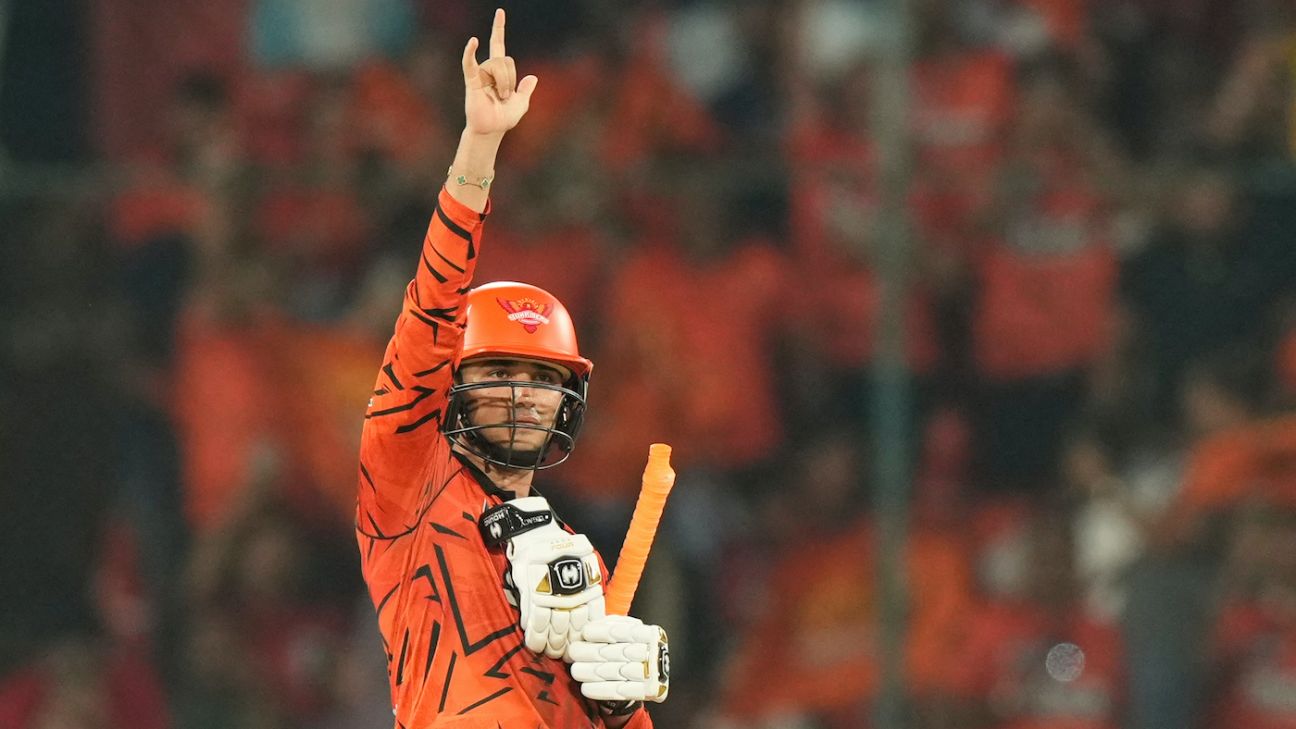
Imagine a Yusuf Pathan who can pace an innings like Virat Kohli - that was Abhishek Sharma on Tuesday nightAbhijato SensarmaPublished: Apr 21, 2026, 7:47 PM (9 hrs ago)1:13Du Plessis: Abhishek is 'elite' on a pitch like thisImagine T20 cricket in 2030. The IPL runs for six months. Teams are allowed four subs per match. Games finish at 1am. Now, imagine the team's biggest hitter playing all 20 overs of their innings. Abhishek Sharma is that guy. He was batting like he's from the future against Delhi Capitals. He faced the first ball of the innings and the last. This compromise meant he scored at least 30 runs less than he could have. He scored plenty more than most others would have managed anyway.Just to be clear, Abhishek toinked his way to an unbeaten 135 off 68 balls: the fifth-highest individual score in an IPL match. All along, he wore his familiar chain tucked under his jersey, and a poker player's expression on his face. Smashing bowlers around the park, business as always.But it wasn't. To understand why, let's travel from the future to the past for a moment. Abhishek breached the same list for the first time last season, slotting in even higher, when he made his scarcely believable 55-ball 141 against Punjab Kings. He went at a strike-rate of 256.36 - exactly 57.84 higher than the rate he kept to on Tuesday. Back then, Sunrisers Hyderabad were chasing 246. Now, they needed to set up a total. They made 242.RelatedFinch to Axar: 'You're not willing to stand up at the moment'Abhishek's 135* blows Delhi Capitals awayWill Jacks links up with MI squad ahead of CSK fixtureThe Parag conundrum - impressive as captain, struggling as batterAyush Mhatre ruled out of IPL 2026 with hamstring injuryThe end result for the team might be nearly identical, but the differing strike-rates lead us to a bigger question: why did Abhishek bat the way he did against DC, objectively slower than he can, and certainly, within his means? He was batting with the same top four, and at his home ground in Hyderabad - a haven for T20 hitting."The way we started, we had a plan, we wanted to use the powerplay," he said. "But the wicket was a bit slow so we had to re-plan, we had match-ups in mind too. [We] wanted to use the powerplay, you don't know what a par score is."He was thrown into rare uncertainty while batting on his home turf. He went into a shell, sure, but there might have been another reason why he decided not to maximise his risk-taking.At the same time, he revealed something even more interesting: "I had a plan. Franky [assistant coach James Franklin] wanted me to bat till the 20th over... This is the first time I've batted till the 20th over [in the IPL]."He is correct about not batting through the innings before. This template is unfamiliar to Abhishek. He usually cares for a good time, not a long time. Opening for India at the international level - their T20 side is closest to living in the future - he can afford to just bosh 40-odd off a dozen balls and then be on his way. What follows is the all-star line-up of big hitters to build on his start: Hardik Pandya, Suryakumar Yadav, Tilak Verma, and Shivam Dube, to name a few.SRH's own middle order has Salil Arora, Aniket Verma, and Nitish Kumar Reddy. All promising batters, but none of them consistent enough to mitigate for all top three batters falling early. Did that play at the back of his mind? SRH's No. 4 Heinrich Klaasen has already pared back his own strike rate from last year - from 172.69 to 153.11 - to score a bucket-load of runs and hold up the back-half of their innings instead. Klaasen finished this night second on the leading run-scorer's chart.On the other hand, Abhishek's two big knocks this season were terminated soon after the powerplay: he fell in the ninth over after bashing 74 against PBKS; in ninth over during his 48, against Kolkata Knight Riders; and in the eighth over after his 58 against Chennai Super Kings. Even after the fielders spread out, he was upping his tempo from sixth gear to seventh gear.Whether it was because of the leanness of the batting line-up or the unexpected slowness of the pitch, he stopped going heavy metal post powerplay. He added a new layer to his batting handbook instead. To bat through the innings. And to adopt the 2030s role of a pinch-hitting anchor: a Yusuf Pathan who can pace his innings like a Virat Kohli.Almost exactly a year ago, he had no choice but to start hitting from the get-go. The required run-rate was above 12 an over before he had even faced a ball. Consequently, he played what the opposing skipper Shreyas Iyer called a "lucky" innings. Not an insult, just the truth. According to ESPNcricinfo's logs, Abhishek's control percentage that night was 66%. He survived wild slashes, drops in the outfield, and his own worst instincts.Today, the same control percentage hovered over 90% for most of his innings. When he mistimed a few in the death overs, it slipped down to settle at a still-respectable 85%. To be in control, he had to strip down his approach to his biggest strength: hitting sixes.He smashed 10 sixes in that rather lucky knock against PBKS last year. He smashed ten tonight. However, no part of him looks lucky when he hits sixes: for such a new-age batter, he loves playing in the V with a straight blade. It is inconsequential exactly how far down leg side he shuffles before he hits a six. When he does, it always sails a comfortable way over the ropes.On the other hand, despite facing 13 more balls against DC this evening, he hit four fewer fours. You might think of this type of boundary as the more risk-free result in T20 cricket. But for a batter like Abhishek, any ball that lands within the boundary is a risk. There are fielders to contend with. And the accuracy of his own placement. Usually, he accepts the risk of getting out early. Today, he only attacked the balls he knew he would be in control of: the ones he could launch out of the park.Kohli knows how to adapt his game to conditions, holding back his ceiling when the team needs him to just bat through the innings instead. He also has the most T20 centuries by an Indian: nine. Abhishek - the successor to his opening slot in the T20I side - equalled that record today. As a bonus, he shot up past Klaasen to the top of the Orange Cap leaderboard.Heavy is the head that makes those many runs, usually as an accumulator of some sort for their franchise. But when Abhishek slipped on the Orange Cap for the cameras, he broke into a smile. He is different from those who came before him. Maybe, the burden of scoring runs isn't so heavy when you're from the future.Abhijato Sensarma is a sub-editor at ESPNcricinfo


Most Popular



UF Hopes 'Common Sense' Leads to Aberdeen Reunion
16 hours ago