How doomscrolling led to Reddy increasing his pace in a week
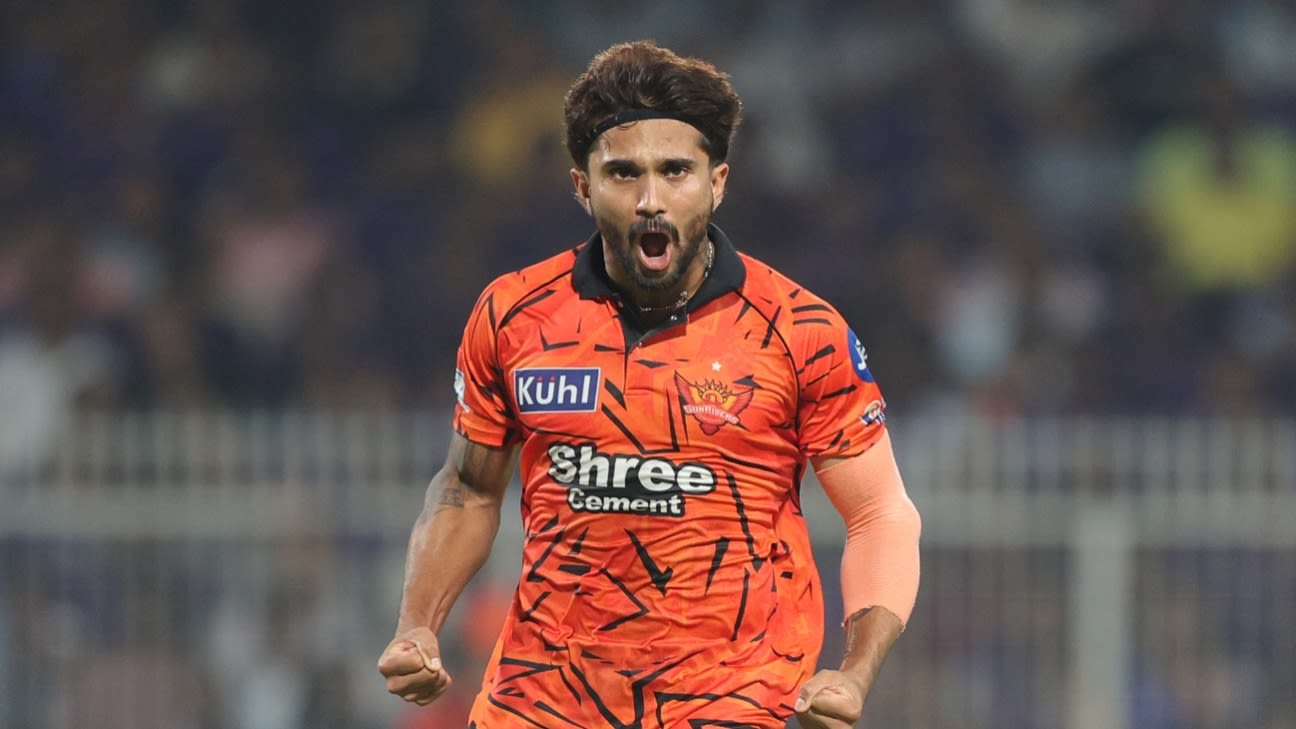
The SRH allrounder worked with Steffan Jones before the IPL and their aim is to make Reddy bowl around 140kph to become one of the best allrounders in the worldShashank KishorePublished: Apr 17, 2026, 2:57 PM (4 hrs ago)Nitish Kumar Reddy may not have realised it then, but casual doomscrolling on Instagram has played a part in his improved speeds at IPL 2026.In February, he contacted Steffan Jones, a former county player and now a fast-bowling and high-performance coach, after the algorithm threw up a series of videos on fast bowling and biomechanics. Intrigued by the clarity and science behind it, Reddy reached out to Jones via DM [through his manager] for the possibility of doing one-on-one sessions, which is now beginning to translate into tangible gains.Last week, the speed gun clocked one of Reddy's deliveries at 139kph, a marked improvement from the mid-120s he was at until not long ago. Over the past five games this season, Reddy has sent down nine overs - already going past the five he bowled through the entirety of IPL 2025 - and has consistently touched the mid-130s. This improvement can be traced back to a week-long camp with Jones, just before the IPL."I'm quite active on social media, which is how my profile was built," Jones, formerly high performance coach at Rajasthan Royals (RR), tells ESPNcricinfo. "I like to share knowledge. I got a message from Nitish's team saying he'd like to work with me if the schedule allows."Timing was tricky with the IPL, but I was heading to South Africa where I have an academy in Stellenbosch. I said I could come for a week."Jones hardly knew about Reddy and hadn't seen him bowl. It prompted him to do some initial research and tap into contacts like Zubin Bharucha (high performance director at RR) and Rahul Dravid (former RR head coach). The two then agreed on a week-long programme at Bengaluru's Dravid Centre of Sports Excellence.Jones' approach is shaped by the realities of the modern game. With no real off-season for cricketers these days, he had to pack in a month's body of work within a week. He structured 10 sessions over seven days, planning each day carefully around when he needed to peak."I knew this was a big season for me," Reddy says. "I was desperate to get this work in before the IPL. The one thing that bothered me over the past year was that my athleticism wasn't translating into my bowling performance or speed. I wanted to rectify that, so I decided to invest in myself."Jones reviewed Reddy's videos on YouTube, social media, and the ones the allrounder had shared. One key clip was from Australia where Matthew Hayden mentioned on commentary that Reddy needed more pace."That video seemed to resonate with him," Jones says. "I'm known for developing speed, I've done it with Ishant Sharma as well. So I studied his technique and knew I'd need to test him physically once I got there."Before they got down to skill work, Jones conducted a number of tests to check Reddy's athleticism. Jumps for lower-body power, medicine ball throws for upper-body power, ball velocity with heavy, light, and normal balls to begin with. Jones also focused on video analysis using AI tools, plus a machine that measures run-up speed, force, and patterns."What I found was key: he ran in on an angle, pelvis facing fine leg, spent too long on back-foot contact, and could run in faster and from further," Jones says of Reddy's angular approach to the crease.The key was to straighten his run-up."He's a very good athlete, one of the best around. So it was about fine-tuning technique and waking up certain muscle," Jones explains. "Bowling is about the brain and getting muscles to function quicker. Speed gains are possible if you understand that."We straightened his run-up, so that the energy goes towards the batter. Fast bowling is a hip-shoulder separation game - pelvis forward, upper body working over it. If you run in on an angle, you block that energy."Jones cites Jasprit Bumrah's example to explain this theory further."The last four strides are crucial - they're the power zone. That explains why someone like Bumrah is able to bowl at high pace consistently even though he literally just walks halfway into his run-up and then takes off. About 20% of ball speed comes from the run-up. We worked on that repeatedly, with constraints like cones, twice a day, with varying intensity."After a week, Reddy's bowling speed clocked about 10kmph faster. "The exact numbers don't matter - people can see the difference," Jones says. "It's visible. A week gives quick gains, but they're not as stable. Over a month, you can 'slow cook' the process it and make changes more ingrained. That's what we'll build towards."Jones also explained that while the emphasis was largely on building speeds, improving just that one aspect in isolation wouldn't have been possible. So they worked on his entire range of motion: wrist position, seam, swing, accuracy, spell consistency, gym work."We covered technical, tactical, and physical aspects," he says. "It's more of an athlete model, like sprinting or javelin, rather than traditional cricket silos."Currently in the USA for a coaching clinic, Jones still has Reddy's IPL plan mapped out in detail. His work desk is pinned with a sheet tracking both his schedule and that of Sunrisers Hyderabad (SRH). The plan is meticulous: when to rest, when to train, the drills to follow, and even the number of repetitions.Having also worked briefly with Varun Aaron, SRH's bowling coach, Jones believes there is a "natural sync" in their ideas, allowing for continuity in Reddy's development."He told me he's following them, even on off days," Jones says. "It's about drills before skills, isolating what's wrong and fixing it properly. After every game. I'm very honest I'll tell him if a slower ball cost him runs, and also what he did well. He looks different now. I think he can be a top allrounder across formats, especially if he bowls 140kph consistently."The clarity Jones has of his methods also extends to how he views the bigger picture of individual coaching in sport."I honestly do think this is the future," he says. "The future of cricket is individuals employing their own coaches. Then franchises just have a head coach and a small group, but each player will have their own coach who they take around the world with them."If you have a bowler playing for five different franchises, who is controlling their workloads? Who is looking after their needs? Cricket is way behind other sports in this regard, but hopefully that will change. It's more like a baseball or NFL model."For now, his focus remains on ensuring Reddy's early gains translate into something more long-lasting."Yeah, I'm keen for it and I know he's keen for it," Jones says of continuing the partnership. "I'm flying to Hyderabad for the KKR game (on May 3). We'll meet there, and I'll also catch up with Varun Aaron. Then we'll come to an understanding of how it works going forward. The aim is to get him consistently into the 140s and develop him into one of the best allrounders in the world."Shashank Kishore is a senior correspondent at ESPNcricinfo

Most Popular



Women's Tennis Wraps Up Season at EMU on Sunday
8 hours ago