Rai of Hope: Punjab da putt-ar wins PGA title
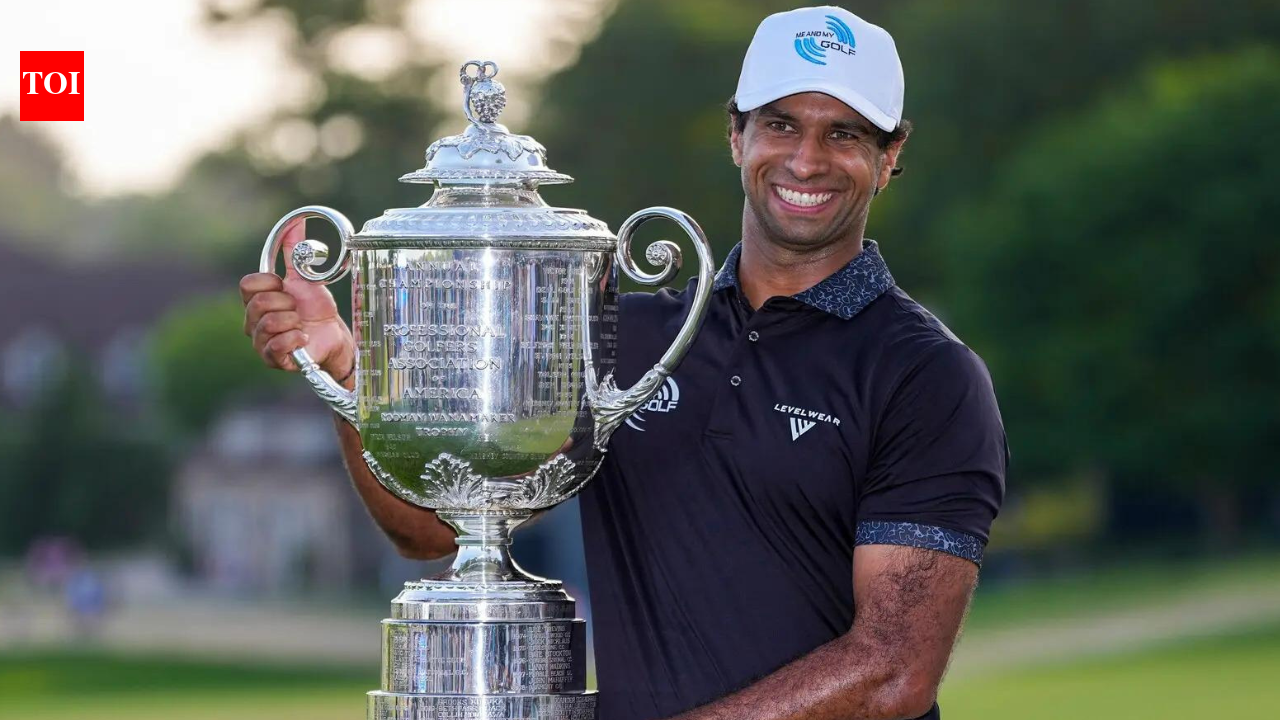
File photoTOI correspondent from Washington: In a sport still associated in India with colonial clubs, corporate memberships, and retirees in pastel trousers, Aaron Rai has delivered a moment that should resonate far beyond the fairways of the west. The low-profile Brit of Indian origin won the 2026 PGA Championship on Sunday evening, becoming the first player of Indian heritage to capture one of golf’s major titles – and doing so with understated precision that has defined his career. Rai entered the title scrap, boiling with eight major champions, ranked 44th in the world. He held off a star-studded leaderboard featuring Rory McIlroy and Jon Rahm to finish with a nerveless final round highlighted by a stunning 68-foot birdie putt that effectively sealed the title. The victory transformed the 31-year-old from respected technician into golfing history-maker. So unexpected was his win that ESPN said he was the biggest long-shot major winner in at least 20 years along with a story headlined “How Aaron Rai outlasted golf's biggest stars to win the PGA Championship.” He had never finished in the top 10 of a major before, and on Saturday, 14 players held a share of the lead, with the analytics website Data Golf putting Rai’s chance of winning at just 3.6%. The insane 69-foot putt on the 17th hole, buried the field. The Brit media went to town, noting that no Englishman had won the title in more than 100 years. For Indian golf followers, the triumph carried the heft of immigrant success. Rai was born in Wolverhampton, U.K to a family of Indian origin whose roots are in Punjab. His upbringing was far removed from the manicured privilege often associated with golf. He has spoken openly about his parents, Amrik Singh and Dalvir Shukla, stretching the family budget to buy him clubs and teaching him to treat them with reverence – which explains why he still uses iron covers, a habit routinely mocked in elite golf circles. Rai’s mother, who introduced him to the sport when he was four via plastic golf set after he was struck by a hockey stick, caddied for him in the early years. The role has now been taken over by his wife Gaurika Bishnoi, who is also a professional golfer from Rajasthan and has been one of India's top women's golfers over the last 10 years, with eight wins in India’s Hero Women’s Pro Golf Tour. He in turn has caddied for her on the European circuit. “I’m not exaggerating when I say that I wouldn’t be here without her,” Rai said at a press conference after the win, acknowledging his family and his Indian and Kenyan ties (his mother emigrated via Kenya). “She (Gaurika) is a professional golfer herself. So her mindset, her advice, her thoughts, whether it’s technique or the way I’m holding myself is absolutely invaluable. Asked how he would be celebrating the win (with a $4 million paycheck that comes with it, Gaurika joked, “He’ll probably have Chipotle.” That modest, immigrant-family story should strike a chord in India, where golf remains an aspirational sport largely confined to affluent urban enclaves, military institutions and old colonial clubs. Unlike cricket, where a tennis ball and open street can launch a career, golf demands expensive equipment, coaching, travel and access to courses that remain out of reach for most Indians. Yet despite those structural barriers, India has quietly produced several world-class golfers. Jeev Milkha Singh became the trailblazer of modern Indian golf, winning four titles on the European Tour and breaking into the world top 30. Arjun Atwal made history in 2010 by becoming the first Indian-born player to win on the PGA Tour when he captured the Wyndham Championship in North Carolina. Then came Anirban Lahiri, whose consistency on the Asian and European circuits carried him into multiple major championships and the Presidents Cup. Shubhankar Sharma briefly electrified Indian golf fans with his rise into contention at World Golf Championships and majors, while women’s golf saw pioneers like Aditi Ashok emerge as global contenders, narrowly missing an Olympic medal in Tokyo. But until Rai’s breakthrough, a major championship remained elusive for golfers of Indian origin. That is partly because golf’s highest level remains among the most difficult sporting ecosystems to penetrate. Unlike tennis or football, where emerging nations occasionally produce sudden prodigies, golf traditionally rewards generations of infrastructure, private coaching networks and elite amateur circuits. India, despite its economic rise, still has relatively few public golf facilities compared with global golfing powers. Rai’s triumph arrives not merely as a sporting achievement but as a cultural moment in a country whose President is hooked on golf. Here is a player carrying visible traces of the Indian diaspora characteristics – disciplined, understated, technically meticulous – prevailing in one of sport’s most psychologically brutal arenas. There is also something distinctly un-Trumpian about Rai’s victory in the age of power golf. He is not known for towering drives or social media swagger. He wears two gloves. He avoids theatrics. He speaks softly. Rai’s victory may not suddenly democratize golf in India. Municipal driving ranges are unlikely to replace cricket grounds anytime soon. But representation matters in sport, particularly in disciplines historically seen as socially exclusionary. For decades, Indian golf fans watched majors as distant spectacles populated largely by Americans, Europeans and Australians. On Sunday night, one of their own – or at least one carrying echoes of their own journey – stood on the 18th green holding the Wanamaker Trophy. And somewhere in India, perhaps at a dusty army course, a corporate driving range or a teenager’s improvised practice net in a narrow lane, golf suddenly looks a little less foreign.End of Article
Most Popular



Who could be the 2026 World Cup's breakout star?
3 hours ago